Baofeng F8HP · Volume 2
Baofeng F8HP — Vol 2: Operations
8-watt 2m/70cm handheld — high-output Baofeng
2.1 Operating modes
The F8HP is analog-FM-only on the two amateur bands plus broadcast-FM RX. There is no DMR, no D-STAR, no C4FM, no P25, no AM aircraft RX, no SSB, no packet TNC, no APRS native (though see §3.4 below for the workaround). The mode envelope is deliberately narrow — this is what keeps the radio cheap and the firmware simple.
2.1.1 FM voice — 2 m and 70 cm
The radio TXes narrow-FM (2.5 kHz deviation, 12.5 kHz spacing) or wide-FM (5 kHz / 25 kHz), selectable per memory channel. Default is narrow-FM, which most modern amateur repeaters use. Always match the repeater operator’s documented setting — wide-FM TX into a narrow-FM repeater overdeviates and clips; narrow into wide sounds quiet on the output. Standard CTCSS (50 tones, 67.0-254.1 Hz) and DCS (104 codes) encode/decode, with split-tone support for link repeaters. DTMF keypad encode for the rare autopatch.
2.1.2 FM broadcast receive — 65-108 MHz
Toggle with the dedicated front-panel button. Audio is mono through the speaker; the speaker-mic jack gives stereo into earbuds via the standard 2-pin-to-3.5mm cable. No RDS, no station-name scan. It works as a portable FM radio; that’s the feature set.
2.1.3 Memory and VFO
128 memory channels, flat list (no zones, no banks). Each stores: TX freq, RX freq (or offset + direction), CTCSS/DCS encode + decode tones, power level (high/mid/low), wide/narrow FM, scan-list flag, busy-channel-lockout flag, and a 6-character alphanumeric name (verify char count for the firmware in your radio — TBD against the unit). 128 slots is generous for typical local operation, tight for a national codeplug. VFO mode tunes any frequency directly via keypad — useful for temporary frequencies not worth a memory slot.
2.1.4 What it doesn’t do
- No cross-band repeat. The VX-8DR doesn’t either; the AnyTone D878 does. If you need to extend HT coverage via a vehicle-mounted repeater, look elsewhere.
- No simultaneous dual-receive. The dual-VFO display is alternating-watch, not true simultaneous reception (which requires two separate receivers).
- No native APRS or packet. External-TNC coupling through the speaker-mic jack works as a documented kludge — fragile audio coupling, finicky PTT/COS keying. The VX-8DR has internal APRS; the F8HP does not.
- No digital voice (DMR, D-STAR, C4FM, NXDN, P25). For DMR, use the AnyTone D878UVII (Vol 8) or the hotspots (Vols 21-22).
- No SSB, no AM aircraft RX (108-137 MHz is not received).
VOX is supported, 10 sensitivity levels, default off (it’s hostile to repeater operators when ambient noise keys the radio inadvertently). Priority scan and busy-channel-lockout are standard.
2.2 Field use
The F8HP’s biggest constraint in the field isn’t the radio — it’s the stock antenna. The default rubber-duck antenna shipped with the F8HP is mediocre by any measure: roughly -3 to -5 dBi at the centre of each amateur band, with significant pattern distortion when held near the body, and noticeable bandwidth limitations at the band edges. The good news: this is trivially fixable.
2.2.1 The mandatory antenna upgrade
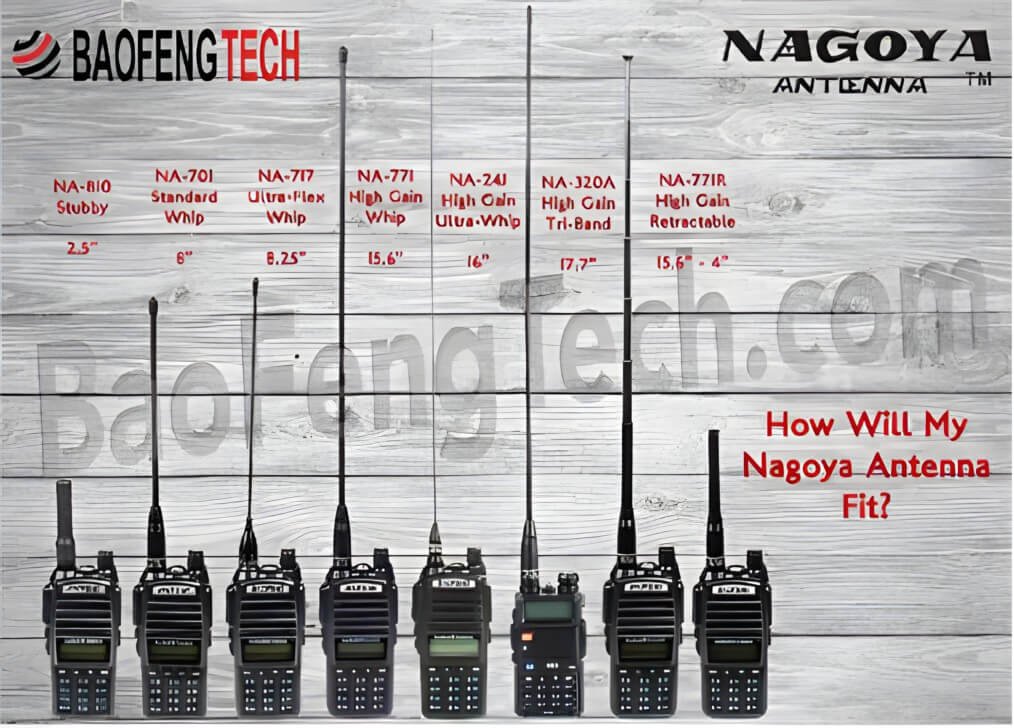
The Nagoya NA-771 (and its many clones) is the canonical Baofeng antenna upgrade — 38 cm fixed whip, SMA-Female, dual-band, ~$20-25 mid-2026. Vs. the stock antenna it delivers ~6 dB gain on 2 m (-3-5 dBi → +2-3 dBi) and ~3 dB on 70 cm (-2-3 dBi → 0-1 dBi). 6 dB on 2 m is 4× effective radiated power — far more impact than the 2 dB you got from spending the extra $20 on the F8HP over the UV-5R. A 5 W UV-5R + NA-771 will out-perform an 8 W F8HP + stock antenna on 2 m. If you bought the F8HP for the 8 W of TX, also buy the NA-771; they compound.
The NA-771 trades length for gain — 38 cm is roughly λ/4 at 146 MHz, which is the geometric reason. The radio becomes substantially less pocket-friendly. For covert carry, the stock antenna or the Diamond SRH-805S (similar trade-off, shorter length) is the compromise.
Deeper antenna theory: Antennas Vol 9 (Portable & mobile monopoles) — geometry, feedpoint impedance, DIY + Buy duality. Per-radio recommendation including the F8HP 4-tier upgrade ladder: Antennas Vol 29 (Use-case Matrix).
2.2.2 Mobile / vehicle deployment
For the vehicle, a dual-band NMO mag-mount (Comet SBB-1, Tram 1185, $40-60 mid-2026) on the roof gives ~3 dBi on 2 m / ~5 dBi on 70 cm plus the vehicle body as ground plane plus elevation. Connection: a few feet of RG-58 to a male-BNC or SMA on the radio end (BNC-to-SMA-F adapter for the F8HP). Long-term installs use a glass-mount (Larsen NMO-GM-150) or trunk-lip mount (Comet RS-720, Diamond K400) to avoid the magnet on paintwork. For VHF/UHF mobile antenna theory see Antennas Vol 9.
2.2.3 Posture
The right posture for the F8HP in this lineup: backup HT in the truck (codeplugged for local repeaters, NOAA WX, 2 m / 70 cm simplex calling, and RACES/ARES/SkyWarn nets — replaceable for $80 if the truck is stolen), loaner for newcomers (cheap enough to lend for a weekend trial), and field-day spare / training radio (the radio you hand to other operators while your primary stays on your belt).
What the F8HP is not the right choice for: daily-driver HT (receive audio grates after hours, no APRS/DMR/IPX rating — use the D878 or VX-8DR); public-safety monitoring (RX bandwidth, image-rejection, and scan speed aren’t engineered for it — use a Uniden scanner, Vols 13-16); mission-critical comms (volunteer SAR, club emergency net — use the VX-8DR with IPX7 and AA tray fallback).
2.2.4 Battery management
8 W TX draws ~1.7-2.0 A from the 7.4 V BL-8 pack; a 2000 mAh pack delivers ~1 hour of continuous high-power TX before low-voltage cutoff. Real TX duty cycles are 5-10 %, so this rarely bites — but the rule: drop to low power (1 W) for any near-line-of-sight repeater contact. Same effective copy at 1/8th the drain; the difference between daily and weekly charging for typical use.
Comments (0)