CubeSat Simulator · Volume 6
Related Projects — Vol 6
6.1 Where the CubeSatSim sits in the wider open-satellite world
The CubeSatSim occupies an unusual niche. It is a ground-based RF simulator — a model that behaves like a satellite (real power subsystem, real telemetry, a real 70 cm downlink) without ever leaving the bench. Surprisingly few projects do exactly that. The things that share its DNA fall into two camps that sit on either side of it: the receive/decode tools that are the other half of its own ground station (the closest functional relatives), and the real open-source flight hardware that makes the opposite design choice — build a satellite that actually flies. This volume maps both, plus the STEM and flight-software projects in the same orbit, so a reader who finishes the deep dive knows where to go next.
A note on rigor: the comparisons below were assembled from each project’s primary site/repo and fact-checked. Two tempting framings did not survive checking and are deliberately left out — an AmbaSat-1 board is not reliably launched to orbit as part of the kit, and a CanSat is not a “ground simulator” (it is a real flying payload). Both are noted in context. Licenses are stated only where confirmed; elsewhere they are marked (unverified) and should be checked against the project before relying on them.
6.2 Closest analogues — the receive / decode side
These are the tightest matches to the CubeSatSim, because they are the ground-station chain it plugs into (Vol 5). The CubeSatSim is the transmitter; these are the receivers.
Table 1 — 1. Closest analogues — the receive / decode side
| Project | What it is | How it compares to CubeSatSim | Find it | License |
|---|---|---|---|---|
| SatNOGS | Open-source global network of automated satellite ground stations, run by the Libre Space Foundation; 11M+ observations. Stations are typically an RTL-SDR + Raspberry Pi — the same chain as Vol 5. | The “scaled-up network” version of your single bench station. Same receive hardware; instead of one operator decoding one sim, it is a worldwide grid auto-tracking real satellites. Closest receive analogue. | satnogs.org | Open source (LSF) (license unverified) |
| gr-satellites | A GNU Radio out-of-tree module (Daniel Estévez) with telemetry decoders for many real amateur satellites — AX.25, GOMspace U482C/AX100, CCSDS, AO-40/FUNcube, and more. | Broader than FoxTelem: where FoxTelem targets the Fox-1 family (and the CubeSatSim’s FSK/BPSK emulation), gr-satellites decodes dozens of flight birds. The natural “what else can my SDR pull down” step after the sim. | github.com/daniestevez/gr-satellites | Open source (license unverified) |
| sgoudelis Ground Station | A GPL-3.0 SDR orchestration suite for RTL-SDR; decodes SSTV, FSK, GFSK, GMSK and BPSK. | Its mode set overlaps the CubeSatSim’s transmit modes almost exactly, so it can decode several of them. ⚠️ Single-developer project; some paths (AFSK/LoRa/GMSK) are work-in-progress. | github.com/sgoudelis/ground-station | GPL-3.0 |
| FoxTelem | AMSAT’s own cross-platform decoder (Vol 5) — the CubeSatSim’s reference decoder. | Not a “related” project so much as the canonical partner; listed here for completeness because SatNOGS and gr-satellites are its peers. | g0kla.com/foxtelem | Open source (AMSAT) |
Takeaway: if a reader wants to do more with the same receiver, point them at SatNOGS (join the network) and gr-satellites (decode real satellites). These are the most direct extensions of Vol 5.
6.3 The “build it for real” cousins — open-source flight hardware
These make the opposite choice from the CubeSatSim: rather than simulate a satellite on the ground, they are open-source satellites that actually fly (or are built to flight standard). They share the CubeSatSim’s open, low-cost, educational ethos but carry the cost, complexity, and regulatory weight of real spaceflight. Good “if you liked the sim, here’s the real thing” material.
Table 2 — 2. The "build it for real" cousins — open-source flight hardware
| Project | Who | How it compares to CubeSatSim | Find it | License |
|---|---|---|---|---|
| PROVES Kit ⭐ | Bronco Space, Cal Poly Pomona (built on PyCubed) | Open-source 1U, targeting sub-$1k — closest in spirit to the CubeSatSim’s open/low-cost philosophy, but real flight hardware. Has flown 3 times; meaningful operation came on the 3rd attempt (~9.5 h deployment). Simulator → real-flight is the leap here. | github.com/proveskit | Open source (license unverified) |
| PyCubed / PyCubed-Mini | PyCubed (orig.); PyCubed-Mini from CMU (Neil Khera) | CircuitPython avionics with magnetorquer ADCS and solar; the 1U board family has flown 3 missions. PyCubed-Mini is a 1p PocketQube research board for universities, schools, and individuals. The platform PROVES builds on. | github.com/pycubed · ri.cmu.edu (PyCubed-Mini) | Open source (license unverified) |
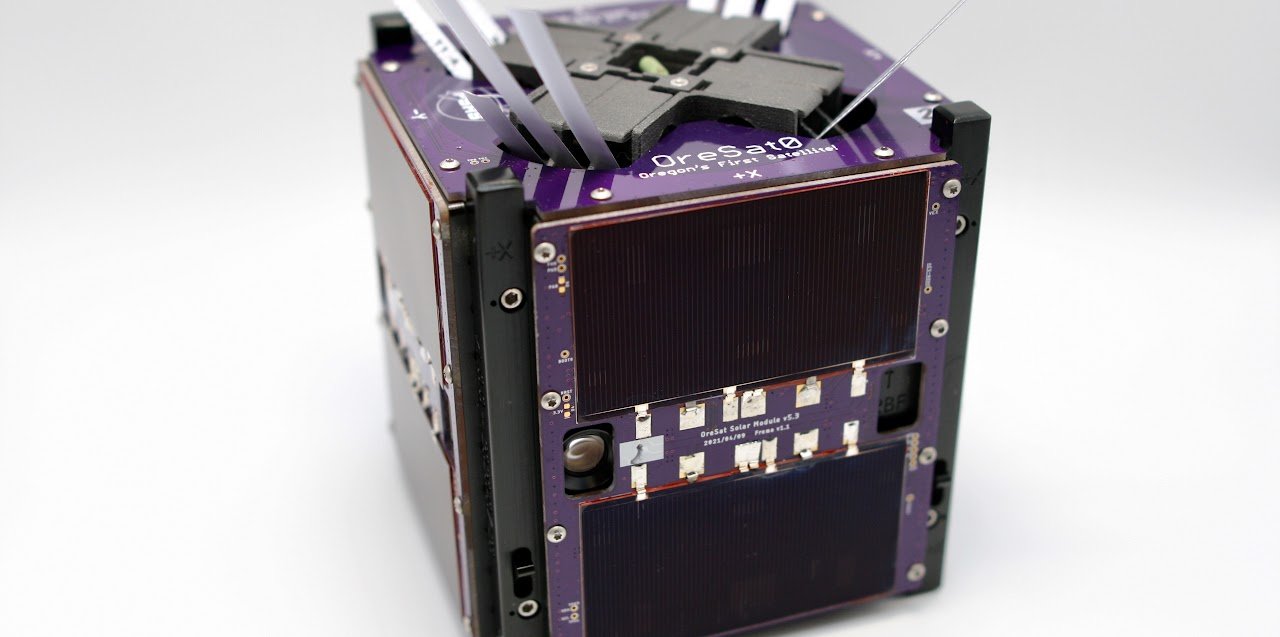
| OreSat | Portland State Aerospace Society | Fully open-source orbital CubeSat program (OreSat0 / 0.5 / OreSat); OreSat0 launched ~Mar 2022 to LEO. Cleanest licensing story of the group. Note: some artifacts withheld for ITAR. | oresat.org · github.com/oresat | HW: CERN-OHL · SW: GPLv3 |
| Artemis CubeSat Kit | Univ. of Hawaii HSFL (NASA Artemis) | Space-ready open-source 1U with full subsystems + camera, CubeSat Kit Bus compliant. Now commercialized via Mahina Aerospace. A turnkey “real CubeSat” kit vs. the sim’s bench model. | sites.google.com/hawaii.edu/artemiscubesatkit · github.com/hsfl | Open source (license unverified) |
| IEEE GRSS Open PocketQube Kit | IEEE GRSS + UPC NanoSat Lab | Complete 1P PocketQube flight HW/SW/BOMs — EPS, ADCS, STM32 OBC, LoRa radio; flew as PoCat-1/2/3. Lowers the entry barrier to a flyable PocketQube. | nanosatlab.upc.edu/en/academy/pockets | Open source (license unverified) |
| AmbaSat-1 | AmbaSat | 35 × 35 mm femtosat kit — ATMEGA328 + gyro/accel/magnetometer + a swappable sensor, LoRaWAN (RFM95) radio. A cheap buildable board for learning. ⚠️ The “and your board launches to orbit” claim did not hold up — treat it as a kit, not a launch service. Radio is LoRaWAN, not 70 cm NFM. | ambasat.com | Commercial kit |
Takeaway: PROVES Kit and OreSat are the two to highlight — PROVES for the matching low-cost/1U/open ethos, OreSat for being a genuinely flown, cleanly-licensed open CubeSat.
6.4 Educational / STEM adjacents
Same teaching mission, different form factor — these are where the CubeSatSim’s educational framing has company.
- ESA CanSat — a can-sized payload competition. The mandatory primary mission is to transmit temperature and pressure by radio at least once per second — a 1 Hz telemetry downlink that is a real conceptual parallel to the CubeSatSim’s telemetry beacon. ⚠️ A CanSat is not a “ground simulator”: it is a real payload that flies (rocket or balloon drop) and transmits during descent. The parallel is the downlink as a teaching tool, not the “simulate on the bench” idea. → esa.int/Education/CanSat
- ARISS (Amateur Radio on the ISS) — schools make scheduled ham-radio contacts with astronauts aboard the ISS. The institutional STEM-radio program the CubeSatSim’s classroom use sits beside. → ariss.org
- High-altitude balloons — near-space telemetry payloads, the balloon cousin of CanSat. AMSAT-UK maintains a beginners’ balloon resource; ARHAB (Amateur Radio High Altitude Ballooning) is the community hub. → amsat-uk.org/beginners/balloons · arhab.org
6.5 Under the hood — open-source avionics & flight software
For the reader who wants to see what real flight software and fully-open satellites look like:
- NASA F´ (F Prime) — the reference open-source flight-software framework (notably flew on the Ingenuity Mars helicopter). The serious answer to “what does real flight software look like.” → github.com/nasa/fprime
- UPSat (Libre Space Foundation) — billed as the first fully open-source satellite (hardware and software) to actually fly. The ideological anchor of the open-space movement and a sibling effort to SatNOGS. → libre.space/projects/upsat
6.6 How these relate back to the deep dive
Table 3 — How these relate back to the deep dive
| If the reader wants to… | Go to… | Deep-dive tie-in |
|---|---|---|
| Do more with the same RTL-SDR receiver | SatNOGS, gr-satellites | Extends Vol 5 (ground station) |
| Build a satellite that actually flies | PROVES, OreSat, PyCubed, Artemis, IEEE PocketQube | Contrast with the sim’s bench model (Vol 1) |
| Teach with a flying payload instead | ESA CanSat, ARISS, HAB balloons | Same STEM mission as Vol 1 |
| See real flight software / fully-open sats | NASA F´, UPSat (LSF) | Beyond the sim’s Pi-based “flight software” |
The single tightest analogue is SatNOGS — it is literally the CubeSatSim’s receive chain scaled to a global network. On the transmit / hardware side, PROVES Kit is the closest in open, low-cost, 1U spirit.
Comments (0)