Midland WR120 · Volume 2
Midland WR120 — Vol 2: Operations
NOAA WX radio with Specific Area Message Encoding alerting
2.1 Operating modes
The WR120 has four operating modes, plus an event-filter overlay that applies to all of them.
2.1.1 S.A.M.E. mode (primary)
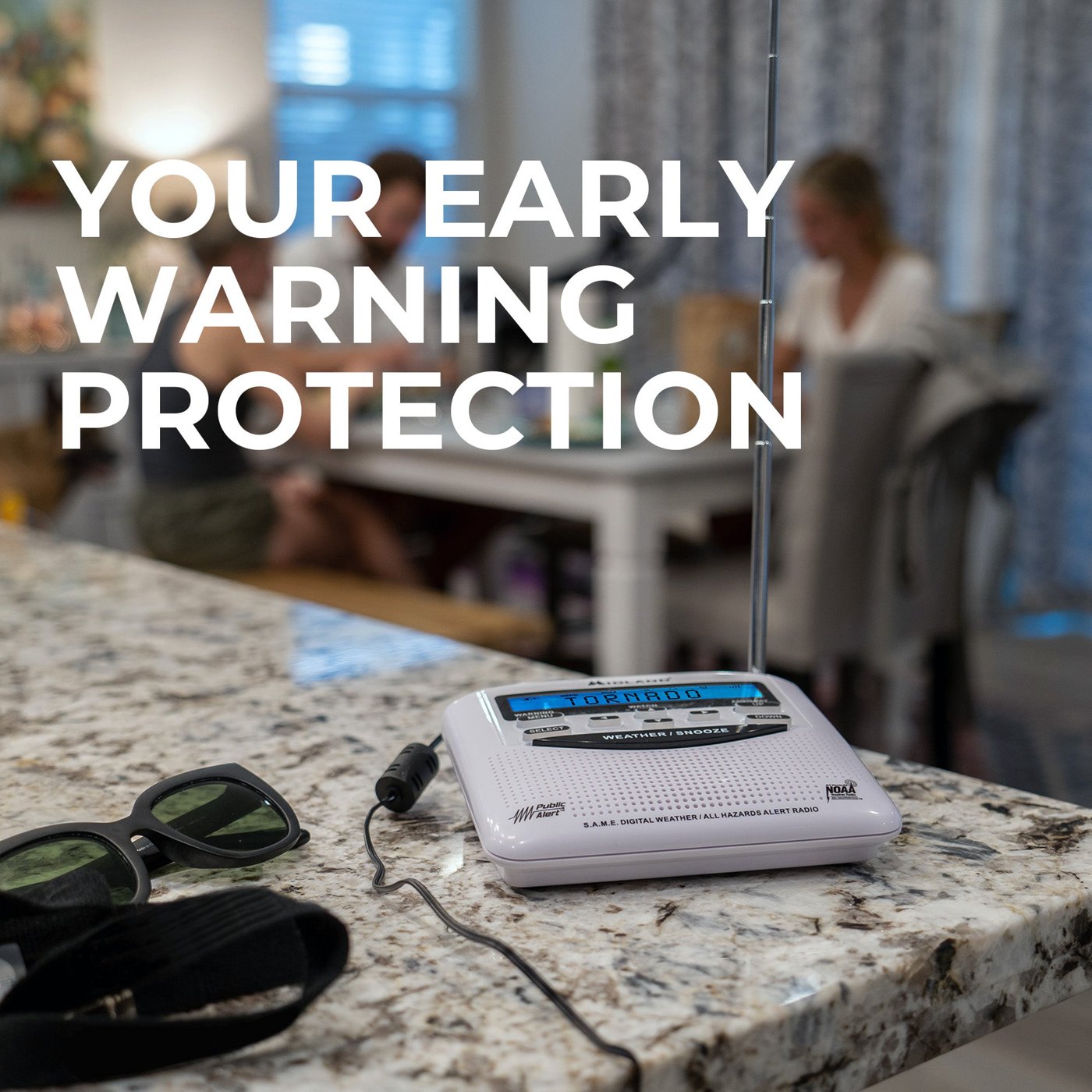
The default. The receiver continuously demodulates the configured NWR channel with audio muted until an alert arrives. When the NWS transmitter sends a S.A.M.E. header — a 1050 Hz alert tone preceded by an AFSK data burst encoding event code, originator, FIPS area code(s), valid time, and effective duration — the WR120 decodes the header, checks the FIPS code(s) against its configured list, and either triggers the alert (LED + siren/voice per alert-mode setting, event code on LCD, NWS voice broadcast through the speaker) or stays silent if FIPS doesn’t match. After three end-of-message (EOM) bursts the unit returns to silent standby.
Up to 25 FIPS codes can be configured (the owner’s manual: “You can program up to 25 different location codes”; no source was found for a lower limit on earlier hardware revisions). This covers multi-county configurations: home + work + parents + travel destinations + child’s school district.
2.1.2 All-hazards (non-S.A.M.E.) mode
If FIPS is left unprogrammed or explicitly disabled, the WR120 alerts on every S.A.M.E. message on the configured channel regardless of FIPS. Useful at temporary locations where you don’t know the local FIPS (alerts on everything until you can look it up), or for regional travel (campground, hotel) where you want all alerts in the broadcast area without configuring multi-county codes for the trip. This mode is exactly why a generic non-S.A.M.E. weather radio is annoying in normal use — every Severe Thunderstorm Warning in any of the 6–12 counties within the NWR transmitter’s footprint triggers the alert, most of which are not where you live.
2.1.3 Manual weather monitoring
Hold the WEATHER button and the radio un-mutes and broadcasts current NWR programming live. Transmitters carry a continuous loop (weather forecast, marine forecast where applicable, current conditions, ~3–5 minute loop) in the synthesized “Tom” / “Donna” / “Paul” / “Javier” voices that have been NWR’s signature since the 2002 Iconix-Webb generator deployment. Used to verify receivability at setup, to listen to the forecast directly (faster than a phone weather app), or to hear pre-storm conditions when an alert hasn’t fired yet but the forecast is concerning.
2.1.4 Alert-mode variants (siren / voice / display)
Independent of channel-mode, the alert presentation can be set to siren (1050 Hz alert tone at full volume — the speaker measures ~75–80 dB at 1 m, not the marketing-claim 90 dB, but enough to wake a sleeping adult through a closed bedroom door); voice (alert tone muted, NWS voice broadcast plays directly — less startling at night); voice + siren (combination; siren during the header tone, voice takes over); or display (completely silent, LCD lights up showing the event code — for newborns’ rooms or recording-studio control rooms).
The Snooze button gives 5 minutes of silence so the voice broadcast can be heard without the siren competing — useful when an alert wakes you and you want to actually parse what NWS is saying.
2.1.5 Event filter (the cross-mode overlay)
S.A.M.E. defines ~80 event codes (TOR Tornado Warning, SVR Severe Thunderstorm Warning, FFW Flash Flood Warning, HUW Hurricane Warning, TSW Tsunami Warning, CAE/CDW AMBER, RWT Required Weekly Test, RMT monthly, NPT national periodic, plus Civil Emergency Messages, Hazardous Materials Warnings, etc.). Full list: https://www.weather.gov/nwr/eventcodes. The WR120 enables/disables each code individually. Defaults are sensible (most everything enabled); the tuning hot spots are RWT (Wednesday late-morning weekly chirp — disable if annoying, but lose the weekly “radio still works” confirmation), CAE/CDW (AMBER — emotional preference; default enabled), and the Statement / Advisory categories (SPS, ESF — low-urgency informational, disable if you only want genuinely actionable Warnings and Watches). Standard configuration is all Warnings + all Watches + RWT enabled, other tests and advisories per preference.
2.2 Field use
The WR120’s “field” is the home. There is no portable / mobile use case — the unit is mains-powered with AA backup, intended to live in one location permanently.
2.2.1 Placement
Three considerations: audible from the master bedroom — the whole point is to wake the household at 2 AM, so the radio belongs there or in an adjacent hallway with the door open, not buried in the basement utility room; AC outlet plus AA batteries installed — the backup is what gets the radio through the outage that typically accompanies the storm; near line-of-sight to the local NWR transmitter — 162 MHz is line-of-sight VHF, so a basement install may receive marginally where a top-floor install with a window toward the transmitter receives cleanly.
2.2.2 Antenna upgrades
The stock whip is adequate for ~90% of US home installations (within ~30 miles of a NWR transmitter, no major terrain obstruction). For the rest, the upgrade path is an outdoor 162 MHz antenna:
- Quarter-wave ground plane: simplest DIY. ~46 cm radiator, four ~50 cm radials at 37° downward, on a 6–10 ft mast at the eaves. ~0 dBi gain with a clean low-angle pattern that catches the NWR transmitter’s line-of-sight signal where the indoor whip is shadowed by walls and roofing material.
- Half-wave dipole: marginally better (~2.15 dBi). NWR is vertically polarized so orient the dipole vertically; horizontal gives ~20 dB cross-polarization loss. See Antennas Vol 6 for the build — center-fed with a 1:1 current BALUN, ~93 cm of #14 AWG copper, end insulators, RG-58 or RG-8X feedline.
- Shared outdoor scanner discone (if you already have one feeding the SDS200 — see Vol 14): a Diamond D-130J or similar covers 162 MHz at roughly 0 to +2 dBi. Tap off for the WR120 via a Mini-Circuits ZFSC-2-1+ 50 Ω splitter (Antennas Vol 18).
The 3.5 mm external-antenna jack on the back of the WR120 needs a 3.5 mm mono plug to female coax (BNC or SO-239) pigtail. Cheap on Amazon or DX Engineering. Verify the WR120 manual for the exact jack type — some revisions use a screw terminal rather than a 3.5 mm jack (TBD — verify against the actual unit).
2.2.3 Posture
Always-on home-base alerter. No licensing concern (receive-only on a public-service broadcast); no operator skill after configuration. Install once, configure once, rotate batteries annually. Multiple units are cheap redundancy — a second WR120 in the workshop or basement (separated from the main living area by ~20 ft of structure that attenuates the upstairs alert) costs $35–45 with no synchronization issue (each sounds its own alert independently). Cross-link: Antennas Vol 29 for shared-antenna context, Vol 22 for the regulatory framing.
Comments (0)