Tecsun PL-880 · Volume 2
Tecsun PL-880 — Vol 2: Operations
Premium shortwave portable with SSB + hidden firmware features
2.1 Operating modes
The PL-880 covers receive-only across the broadcast and amateur HF spectrum, plus FM broadcast with RDS and AM aircraft. The detailed band breakdown:
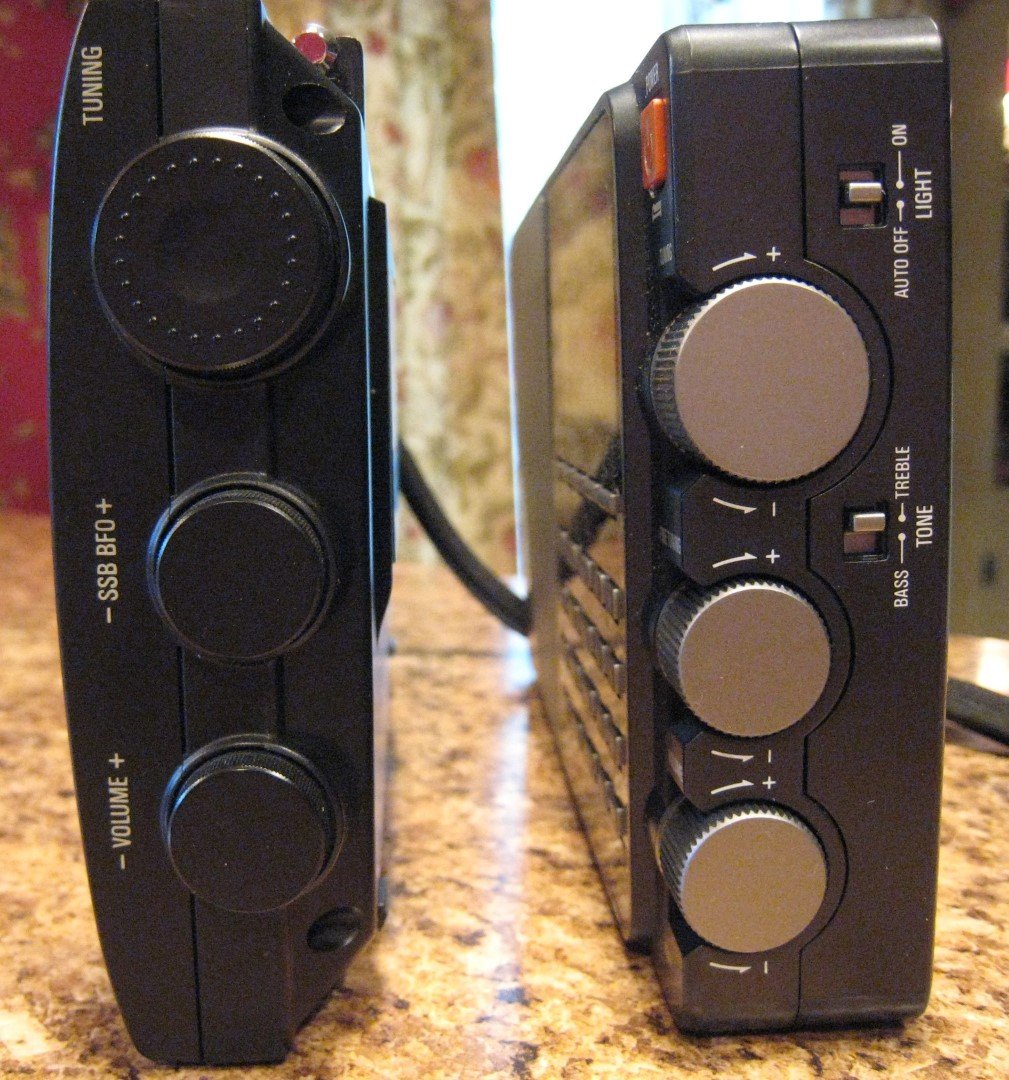
2.1.1 LW (Long Wave)
Coverage: 100-519 kHz, AM modulation only. LW broadcast is largely dead in North America but remains active in Europe, North Africa, and parts of Asia (RTÉ Ireland on 252 kHz, BBC Radio 4 on 198 kHz which finally shut down in 2024-25, Algerian state radio on 252 kHz, various European broadcasters in the 153-279 kHz band). LW also includes the time-station outputs — DCF77 (77.5 kHz German time), MSF (60 kHz UK), WWVB (60 kHz Colorado, drives radio-controlled clocks across the US). The PL-880’s LW sensitivity is adequate but not exceptional; for serious LW DX, an external loop or beverage outperforms the internal antennas substantially.
2.1.2 MW (Medium Wave / AM Broadcast)
Coverage: 522-1620 kHz (1710 kHz on some units depending on region setting; the upper limit is set by the AM broadcast band’s regional plan — ITU Region 2 / Americas runs to 1700 kHz). Tuning steps: 9 kHz (Europe/Asia/Africa) or 10 kHz (Americas/Pacific), selectable. The PL-880 uses an internal ferrite-rod antenna for MW; rotating the radio’s chassis rotates the antenna’s null and is the primary technique for nulling out a strong local station to hear a weaker one underneath. AM sensitivity is good; selectivity is excellent with the narrow bandwidth filters (1 or 1.6 kHz) engaged for tight channel separation in crowded bands.
2.1.3 SW (Short Wave)
Coverage: 1.711-29.999 MHz, AM and SSB modulation. This is the radio’s headline band. Covers all 14 international shortwave broadcast bands (120 m / 90 m / 75 m / 60 m / 49 m / 41 m / 31 m / 25 m / 22 m / 19 m / 16 m / 15 m / 13 m / 11 m) plus all amateur HF allocations (160/80/40/30/20/17/15/12/10 m). For amateur SSB monitoring, switch the mode to USB (for 30/20/17/15/12/10 m per convention) or LSB (for 160/80/40 m per convention), engage the fine-tune for clarifier control, and tune by the main knob.
The SW front end is fairly broad — the radio doesn’t have selectable preselectors per band like a tabletop receiver, but the bandwidth filters in the IF give enough selectivity for crowded conditions. Image rejection is good (mostly an issue with cheap single-conversion portables; the PL-880 uses a dual-conversion architecture).
Sensitivity is competitive with high-end portables: approximately 0.8 µV for 10 dB S/N at the antenna terminal across most of HF, degrading slightly above 22 MHz where the front end’s tracking starts to drift. The internal whip captures enough signal for casual broadcast listening anywhere outside a heavy-RFI urban environment; for serious DX or any amateur HF weak-signal work, an external longwire is mandatory.
2.1.4 SSB (USB / LSB)
USB (upper sideband) and LSB (lower sideband) modes are manually selectable across the entire 1.711-29.999 MHz SW range plus the lower edge of the LW range. The carrier insertion is implemented in DSP after the AM envelope detector; the fine-tune knob shifts the BFO offset in 10 Hz steps, giving voice-pitch adjustment from approximately ±2.5 kHz around the nominal channel. This is the equivalent of a clarifier on a proper transceiver, and it’s the feature that makes amateur HF SSB monitoring genuinely pleasant on the PL-880 rather than a chore.
SSB bandwidth options: 0.5, 1.2, 2.2, 3, 4 kHz. The 2.2 kHz setting matches a standard amateur SSB transmission bandwidth and is the default for voice; 1.2 kHz tightens the audio for crowded conditions; 4 kHz opens it up for AM-equivalent quality when listening to an AM ham on 75/40 m. The 0.5 kHz mode is for CW reception with the radio in SSB mode (offset the BFO by 600-700 Hz to pitch the CW tone into the audible range).
2.1.5 FM (Broadcast) with RDS
Coverage: 87-108 MHz (76-108 MHz in Japan/Asia mode, selectable). Stereo demodulation through headphones; the internal speaker is mono. RDS (Radio Data System) decodes the station name (PS), program type (PTY), and traffic announcements (TA) inline on the LCD. RDS works on US stations that broadcast it (still a minority; Europe is much more widely deployed). The FM front end is sensitive enough to pull in fringe-area stations with a whip; for serious FM DX, the radio benefits from an external dipole or yagi at the headphone-jack-compatible “Wide FM” antenna position (some accessories exist for this).
2.1.6 AM Aircraft (Air Band)
Coverage: 118-137 MHz, AM modulation. The civil air-traffic-control voice band — tower, ground, approach, en-route center frequencies. The PL-880 covers this band on the FM/airband whip, not the SW antenna. AM modulation is selected automatically when air band is tuned. Sensitivity is adequate for monitoring controllers within ~50 km line-of-sight; for serious airband monitoring, the dedicated scanners (Vol 13 Uniden SDS100 / Vol 14 SDS200) far outperform with selectivity and squelch. The PL-880’s airband is a “while I’m holding it anyway” feature, not a primary airband receiver.
2.1.7 Memory presets
Approximately 3050 memory channels, organized into pages by band. Each memory stores frequency, mode, bandwidth, AGC setting, fine-tune offset. Memories are accessed by page-and-number lookup; the ATS (Auto Tuning Storage) function scans a selected band and stores all active stations into a memory page automatically — useful for filling MW or FM presets at a new location in seconds. The ETM (Easy Tuning Mode) is a transient version: ATS-style scanning that writes into a temporary memory list which doesn’t survive a power cycle, useful for “what’s on tonight on 49 m” sweeps without polluting permanent memories.
Permanent memory page layout is roughly: 100 pages × 30 channels per page, with some pages locked to specific bands (e.g. ETM pages for SW broadcast band sub-allocations).
2.2 Field use
Posture: The PL-880 is the lineup’s premier travel radio. It fits in a backpack side pocket, the included nylon carrying case adds a soft layer of protection, and the standard 18650 Li-ion cell charges from any USB supply, and a spare cell is easy to carry. The classic deployment is hotel-room SWL on international travel — set up on the nightstand, telescopic extended toward the window, fall asleep to the BBC.
Indoor RFI: The PL-880’s biggest enemy is modern indoor electrical noise. Switching power supplies (laptop chargers, LED bulbs, cellphone chargers, USB-C PD bricks), powerline networking gear (HomePlug AV/AV2), poor-quality LED-strip drivers, modern furnaces and HVAC controllers — every one of these dumps broadband noise across HF, often raising the noise floor by 20-30 dB. In a typical 2026 suburban home interior the noise floor between 5 MHz and 15 MHz sits at S5-S7 on the PL-880’s meter even with everything off in the room. To listen meaningfully, you either move to a quieter location (the kitchen at 2 AM is dramatically quieter than the living room with the TV on) or you raise signal by using a better antenna.
2.2.1 Antenna pairing
The stock telescopic is fine for casual broadcast SWL. For anything serious — DX, weak signals, amateur HF SSB monitoring — an external antenna via the 3.5 mm mono jack on the left edge gives 10-20 dB of S/N improvement in typical conditions.
Practical external-antenna options for the PL-880:
Table 1 — Practical external-antenna options for the PL-880:
| Antenna | Cost (mid-2026 USD) | What it gives | Cross-link |
|---|---|---|---|
| Random-wire 30-100 ft thrown out a window | $5-15 (just wire) | Strongest signal capture; most prone to local-RFI pickup; needs a 9:1 UNUN for impedance match into the PL-880’s high-Z whip-equivalent input | Antennas Vol 10 |
| End-fed half-wave (EFHW) for 40/20/15/10 m | $80-150 (commercial), $30-50 (DIY) | Resonant on the ham bands; quieter than a random wire because it’s tuned; needs a 49:1 UNUN | Antennas Vol 10 |
| Active receive loop (YouLoop, MLA-30+, K9AY) | $40-300 | Indoor-friendly; rejects local noise via the magnetic-loop directional null; the indoor-DX antenna of choice when no outdoor option exists | Antennas Vol 15 |
| PA0RDT mini-whip on a balcony rail | $30-60 | Active vertical whip; small physical footprint; works well for general SWL in apartments | Antennas Vol 15 |
| Tecsun AN-200 / AN-100 medium-wave loop | $30-50 | Tuned ferrite-loop specifically for the MW broadcast band; dramatically improves AM DX | (vendor accessory) |
The cheapest meaningful upgrade is a 30-50 ft length of insulated stranded wire thrown out a second-floor window, fed through a 9:1 UNUN (Antennas Vol 16) into the 3.5 mm jack via a short coax pigtail. Total cost: ~$30 of parts. SWL transformation: dramatic. The biggest single improvement you can make to a PL-880 deployment.
For the indoor-only case (apartment, HOA, weather), the YouLoop (Airspy’s passive magnetic loop) or W6LVP receiving loop outperforms any wire antenna for noise rejection — the loop’s magnetic-pickup geometry rejects the locally-radiated electric-field noise from indoor electronics by 20-40 dB. The PL-880 + YouLoop combination is a documented hotel-room DX setup; it’s small, foldable, packs in a checked bag, and turns a 14th-floor hotel window into a usable HF SWL setup.
2.2.2 Travel kit composition
A practical travel-SWL kit built around the PL-880: PL-880 in the nylon Tecsun case; a spare 18650 Li-ion cell; Type-C USB cable + wall charger; wired headphones (Bluetooth introduces RFI from the radio’s audio chain); 30 ft insulated wire on a bobbin + 9:1 UNUN + 6 ft RG-58 with 3.5 mm mono at the radio end; a small log notebook; current SW broadcast schedule on phone (Eibi, Aoki). Total kit weight ~1 kg in a 1 L pouch; sets up in 5 minutes.
Receive-only across SW, FM, and air band is unregulated in every country with a functional government — listening to broadcasts is never licensed. The PL-880 travels through customs anywhere; no declarations, no carnet. The one global rule: don’t connect external antennas during a flight (airline RF restriction).
Comments (0)