Xiegu XPA125B · Volume 2
Xiegu XPA125B — Vol 2: Operations
100W HF/6m amp with built-in antenna tuner
2.1 Operating modes
The amp is mode-agnostic: it amplifies whatever the drive radio sends. The interesting question is what each mode does to the amp’s thermal and protection circuitry.
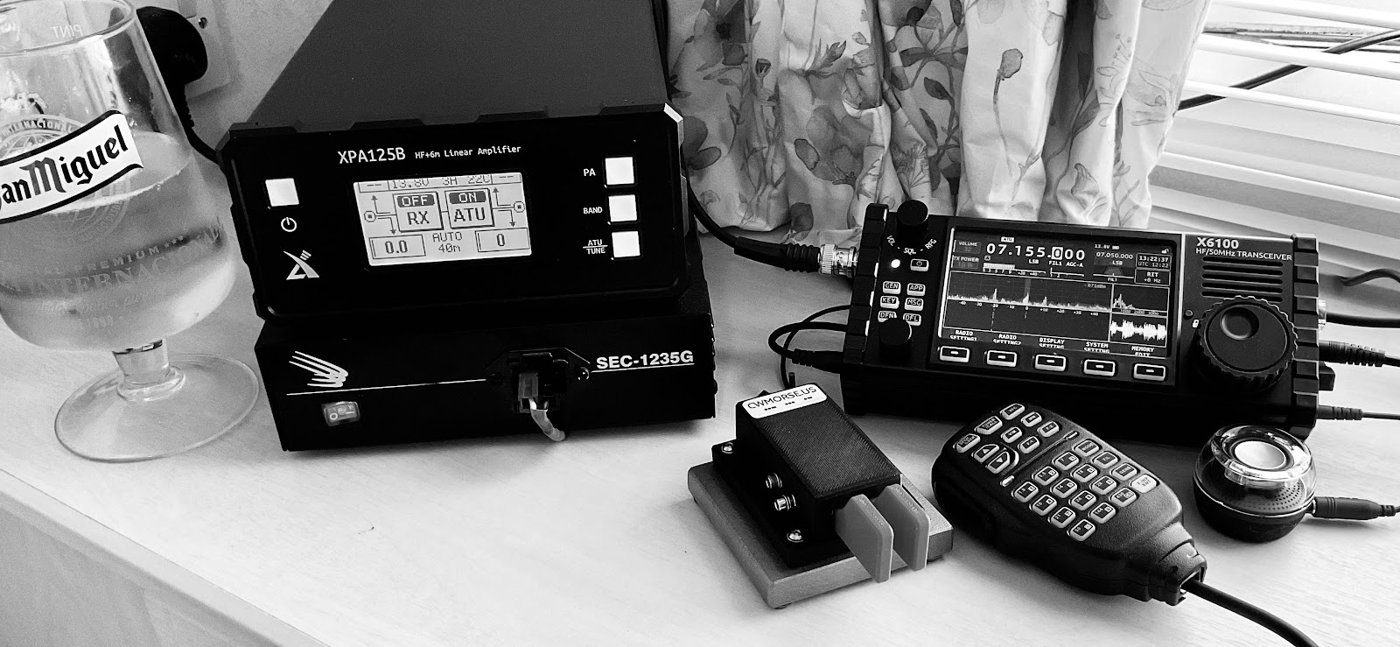
2.1.1 SSB (USB/LSB voice)
The friendliest mode for any linear amp. Voice peaks hit 100 W only briefly; the average power is more like 20-30 W. The fan barely spins; thermal trip is essentially impossible during normal conversation. The amp will SSB indefinitely at full rated output, days at a time — the duty cycle is just too low to heat-stress anything.
ALC matters for SSB: without it, the rig’s audio compressor or speech processor can drive the amp past its linear region on voice peaks, producing splatter (intermodulation products spreading sideways into adjacent frequencies). Connect the ALC cable, set the ALC threshold so the green ALC indicator just barely flickers on voice peaks, and the amp stays clean.
2.1.2 CW (Morse code)
100 W key-down CW is a 100% duty cycle while the key is held. A long string of dahs (or a tune-up call) heats the heatsink rapidly. The amp handles QSO-rate CW (5-25 WPM, normal letter-spacing) without trouble — the gaps between elements give the heatsink time to shed heat. 30+ seconds of continuous key-down at full power will trigger thermal trip; the amp recovers in 1-2 minutes.
For CW tune-ups, drop the rig’s drive to 20-30 W output (i.e., 1-2 W of drive into the amp, ~20 W out) and tune at that level. There’s no reason to tune at 100 W — the tuner finds the same match at any power level, and you’re just heating the amp pointlessly.
The amp’s RF VOX has a hold time (the amount of time it stays in TX mode after RF disappears) that’s typically tunable in the menu. Set it long enough that a dit-pause-dit sequence doesn’t drop the amp back to RX between elements — typically 100-300 ms. Too short and the relays chatter; too long and the amp doesn’t release for the next station’s transmission. Hardware PTT bypasses this entirely (the rig controls TX/RX timing directly), which is the cleaner approach for CW.
2.1.3 AM
AM at “100 W” usually means 100 W carrier + 100 W peak sideband — i.e., 400 W PEP. The XPA125B is rated for 100 W PEP, not 100 W carrier; back off the drive so the carrier is ~25 W, which means PEP peaks (with 100% modulation) hit the rated 100 W. The amp will run AM at this level continuously.
Few hams operate AM voice these days, but the AM broadcast band, AM aero, and a handful of vintage-equipment 75 m AM nets remain. The mode works; just respect the carrier-vs-PEP math.
2.1.4 FM
FM is 100% duty cycle while the carrier is on. Treat FM like CW for thermal-management purposes: short transmissions (under 30 seconds) are fine at full output; long ones will thermal-trip. For 2 m / 70 cm FM you wouldn’t be using the XPA125B anyway (it’s 1.8-54 MHz only). For 10 m FM (29.6 MHz repeater inputs, mostly) and 6 m FM (50.0-50.1 MHz simplex, 52-54 MHz repeater inputs in some regions), the amp works, but be mindful of long PTT holds. Repeater operators in particular hold the key for the duration of a transmission, which can run a minute or more — drop to 50 W if you’re going to be talking that long.
2.1.5 Digital modes (FT8, FT4, RTTY, PSK31, JS8Call)
Digital modes are 100% duty cycle during a transmission. FT8 transmits for 12.6 seconds per 15-second slot; FT4 transmits for 4.5 seconds per 7.5-second slot. The duty ratio (TX time / total cycle time) is roughly 85% for FT8 and 60% for FT4 in continuous operation.
For FT8 at 100 W continuous, the amp will heat up steadily — the fan will run constantly, and after 15-30 minutes the heatsink will be hot enough that thermal trip becomes possible if the room is warm or air circulation is poor. The practical mitigation is to run digital modes at 50-70 W rather than 100 W: it costs you ~3-1.5 dB on the receiving end (often invisible to FT8’s marginal-signal detection), drops dissipation by half, and the amp runs at it indefinitely.
Most FT8 operators don’t actually need 100 W. The mode’s whole point is decoding signals 24 dB below the noise floor; 50 W getting through a contact is no different from 100 W getting through the same contact. Save the heat.
RTTY at 100 W is the worst case — it’s a continuous AFSK tone, 100% duty cycle, for as long as the transmission lasts (multi-minute contests aren’t unusual). Don’t run RTTY contests at 100 W on this amp: drop to 50 W or expect thermal trips. RTTY is dying out anyway, but if you operate it, plan around the thermal budget.
2.2 Field use
2.2.1 Antenna pairing
At 100 W out, antenna quality matters more than it does at 5 W. The forgiveness budget shrinks: a stealth random-wire that worked passably at QRP can present 8:1 SWR at the amp, which the integrated tuner cannot match, and the amp will foldback-protect rather than transmit.
For specific per-radio antenna recommendations including the X6100 + XPA125B pairing, see Antennas Vol 29 (Use-case Matrix). High-traffic-pairings:
- Resonant HF dipole (single-band or trapped multi-band) — the easiest pairing. Cut for the band, fed with 50-100 ft of LMR-400 or RG-213, presents ~50-75 Ω at the feedpoint. SWR <1.5:1 across the band; the internal tuner barely has to work. See Antennas Vol 6 (Single-band dipoles).
- End-fed half-wave (EFHW) — the popular portable choice. The 49:1 UNUN at the wire’s high-impedance end (Antennas Vol 16 (BALUNs and UNUNs)) drops 2450 Ω to 50 Ω. Pair with a 1:1 current choke at the UNUN to suppress common-mode currents on the feedline — at 100 W, common-mode currents can light up household electronics and give you RFI complaints from the neighbors. See Antennas Vol 10 (Random wire & end-fed).
- Multi-band trap dipole or fan dipole — the home-station alternative to swapping single-band wires. Slightly lossier than dedicated dipoles, but the amp’s internal tuner makes up the difference. See Antennas Vol 7 (Multi-band & specialty dipoles).
- Vertical (Hustler 4/5/6-BTV, GAP, R-7000) — fine at 100 W; the tuned-trap verticals expect ~50 Ω at resonance; the amp’s tuner trims out any installation-deviation mismatch. Requires a good ground/radial system (see §6.5 below and Antennas Vol 20 (Grounding)).
- Random wire (any-length, fed via 9:1 UNUN) — the stealth choice. Works at 100 W but the tuner gets a workout, and SWR varies dramatically across bands. Pair with an external tuner (Antennas Vol 17) for the bands where the internal tuner can’t find a match.
- Magnetic loop — careful. Most amateur mag loops are rated for ~100 W intermittent but with arc-over risk at the high-Q tuning cap. Check the loop’s rated power; some are 50 W or less.
2.2.2 Feedline
For a 100 W station, feedline loss is real money. A 100-foot run of RG-58 at 28 MHz loses 2 dB (40% of your power, dissipated as heat in the coax). The same run in LMR-400 loses 0.5 dB (~10%). At 50 MHz the gap widens to 2.5 dB vs 0.8 dB. Use LMR-400 or better for any feedline run over 30 ft. See Antennas Vol 5 (Feedlines) for the full coax-loss table.
For portable use where weight matters, LMR-240 is a reasonable compromise — half the weight of LMR-400, ~30% more loss. RG-8X is acceptable for short (under 15 ft) jumpers but the cumulative loss across a long deployment is brutal.
2.2.3 Power supply
The amp draws 20-22 A at peak; the supply needs headroom. A 25 A bench supply (Astron RS-25M) is the minimum; 30-35 A (RS-35M, MFJ-4230MV, Powerwerx SS-30DV) gives margin. Sub-25 A supplies will sag under load and the amp will throttle back, costing you output power on voice peaks.
For portable battery use, the math is roughly:
- 100 W SSB voice, average drain ~6 A. A 30 Ah LiFePO4 battery lasts ~5 hours of active transmit (or 12+ hours of mixed RX/TX at typical operating ratios).
- 100 W FT8 continuous, average drain ~18 A. The same 30 Ah battery lasts ~1.5 hours.
- 100 W CW QSO, average drain ~10-12 A. ~2.5-3 hours.
The 1 A idle drain matters for battery ops — power-down the amp during RX-heavy stretches.
Voltage cabling: use 12 AWG or heavier for any run over 6 ft. Voltage drop across thin cabling at 22 A will hold the amp at ~12.0 V instead of 13.8 V, and the amp will protest with reduced output. Anderson Powerpoles are the de-facto standard amateur connector; crimp them properly with the right tool (not pliers).
2.2.4 SWR and protection
The amp foldback-protects when:
- SWR exceeds ~3:1 (variable by band)
- Heatsink temp exceeds ~70-75 °C
- Supply voltage drops below ~11.5 V or rises above ~15.5 V
- Forward power exceeds ~120 W (drive too hot)
- Reflected power exceeds ~25-30 W (mismatch too severe)
Foldback means the amp drops to a low-power “safe” state and lights the fault indicator. It does not immediately damage the amp — the protection is designed to be re-armable by power-cycling. Repeated foldback events do cumulative damage to the LDMOS finals over time, though, so treat foldback as “fix the problem before transmitting again” rather than “ignore and continue”.
The single most important habit: do an autotune on every new band before transmitting at full power. It takes 3 seconds, prevents 90% of foldback events, and protects the finals. Build the muscle memory.
2.2.5 Grounding
At 100 W, RF on the wrong surfaces is a real problem. Ground the amp chassis to the station ground via a heavy (8-10 AWG) bonding strap to the same single-point ground as the rig and the antenna system. Don’t trust the negative power lead to provide ground — it’s a 12 V DC return, not an RF ground.
The full grounding deep dive is Antennas Vol 20 (Grounding). The minimum: a single-point ground bus near the operating position, with the amp, rig, computer, and any external tuner all bonded to it; lightning suppressors (Polyphaser IS-50UX or equivalent) at the feedline entry point; ground-rod field outside the shack tied to the bonding system.
2.2.6 Posture — portable vs home base
The XPA125B is heavy enough (~1.5 kg) and power-hungry enough (~20 A peak) to be a marginal portable companion. Most users keep it as a home-base amp paired with a wall-powered station, and run the X6100 standalone (5-10 W) for true portable POTA/SOTA activations. A few users do haul the amp out to field-day setups with a Bioenno 40 Ah LiFePO4 — workable but heavy.
The sweet spot is: X6100 standalone for portable, X6100 + XPA125B for home/base. Same rig, two operating modes depending on where you are.
Comments (0)