Tecsun PL-880 · Volume 1
Tecsun PL-880 — Vol 1: Introduction & Hardware
Premium shortwave portable with SSB + hidden firmware features
1.1 About this volume
The Tecsun PL-880 is the flagship shortwave portable from Tecsun (the dominant Chinese receiver manufacturer through the 2010s and into the 2020s), released in late 2013; its firmware reached version 8820 that year, with only a “silent” 2015 revision under the same number documented since. It earns the bench slot as the dedicated SWL receiver — the bench-drawer companion you reach for when the goal is to listen, not to operate. BBC World Service on 9.410 MHz, Radio France International on 17.620 MHz, Radio Habana Cuba on 6.000 MHz, the WWV time-pip on 5/10/15 MHz, CHU Canada on 3.330/7.850/14.670 MHz, the 41 m and 31 m shortwave broadcast bands packed with international religious and propaganda outlets, amateur 40 m and 20 m SSB in the late evening — all heard cleanly on stock telescopic, much better on an external longwire. As of mid-2026, the radio sells for $160-200 USD depending on US retailer (Anon-Co’s official price runs $189; eBay and Amazon resellers float between $155 and $210).
Why the PL-880 over its cheaper siblings (PL-310ET, PL-330, PL-368, PL-660, PL-680): better SSB with proper carrier reinsertion and a usable fine-tune knob, larger LCD, better front-end filtering against AM-broadcast-band overload, wider IF bandwidth selection (1/1.6/2/2.3/2.5/3/4/6 kHz AM; 0.5/1.2/2.2/3/4 kHz SSB), more memory presets (~3050), and a hidden firmware menu exposing calibration, AGC threshold, and audio shaping not in the printed manual. The PL-660 was the previous flagship and is still capable; the PL-880 is the one to buy new in 2026 if budget allows.
Why this over the Xiegu X6100 (Vol 9) for SWL: the X6100 has a spectrum waterfall and wider RX, but it’s a 1.5 kg transceiver tied to a desk, tuner, and power supply. The PL-880 is 478 g, runs all night on its internal Li-ion cell, and gives up almost nothing on a clean broadcast signal. The X6100 wins on weak-signal HF SSB and visual spectrum; the PL-880 wins on portability, battery life, and speaker. Complements, not substitutes. The PL-880 is receive-only by design — no TX path, no microphone, no PTT. RX of broadcast SW is unregulated everywhere; RX of amateur HF SSB is legal everywhere; the ECPA carve-outs from Vol 1 §4 ↗ don’t apply because nothing the PL-880 tunes is restricted.
1.2 Hardware tour
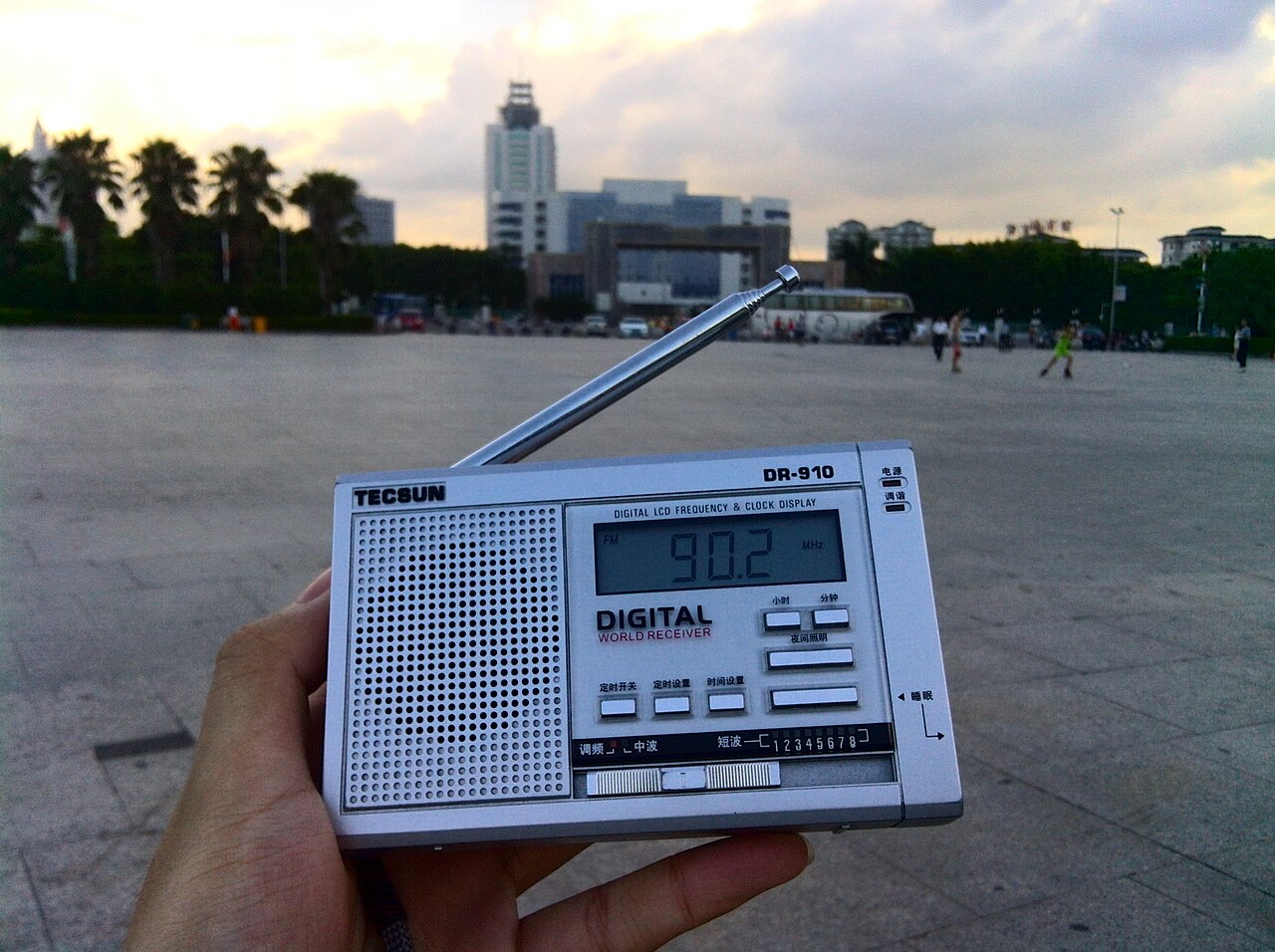
The PL-880 is a horizontally-oriented handheld at approximately 191 × 117 × 32 mm (7.5 × 4.6 × 1.25 in), weighing 478 g without its battery. The form factor is the classic Tecsun-flagship layout — speaker grille on the left third of the front face, LCD top-right, keypad mid-right, two rotary knobs on the right edge.
Front panel (left to right):
- Speaker grille — covers a 50 mm full-range driver. Unusually good for the size; cabinet resonance well-damped; bass rolls off around 250 Hz but voice content is articulate.
- LCD — monochrome STN with switchable green-amber backlight, ~60 × 40 mm. Shows frequency (1 Hz in SSB, 1 kHz in AM/SW), mode, bandwidth, signal-strength bargraph, an unusual numeric S/N estimate in dB during AM/SSB, battery state, AGC mode, RDS data on FM, clock and alarm.
- Numeric keypad — 0-9, decimal, [Freq] entry trigger, mode/band select, ATS (auto tuning storage), ETM (easy tuning mode — sweeps a band into a temporary preset bank), page selectors (the firmware version is shown via the [AM BW] key — see Vol 4), time/alarm/sleep timers.
Right edge — the two knobs. The main tuning knob is a detented rotary encoder; step size depends on band/mode (AM/SW coarse 1/5/9/10 kHz selectable, SSB 1 kHz coarse). The fine-tune knob below it is the killer feature for SSB — 10 Hz steps independent of the main frequency, acting as a clarifier so you park the main knob on the nominal channel and dial in pitch with the fine-tune. Generic-portable SSB without this knob is painful; the PL-880’s implementation alone justifies a chunk of the price premium.
Top edge. Telescoping whip (~95 cm extended, 7 sections, swivel base) serves SW, MW (as inductive coupling to the internal ferrite-rod MW antenna), FM, and air. Internal ferrite-rod antenna handles MW/LW; rotating the chassis rotates the null and is the primary technique for picking apart MW stations.
Left edge. 3.5 mm stereo headphone jack (also drives line-level for recording). Fixed-level line-out on most production runs. 3.5 mm mono external antenna jack — wired for SW/AM only; FM/air stays on the whip. Internal switching auto-disconnects the whip when something is plugged in. USB charging port is Type-C on units shipped after ~2022, mini-USB on earlier units; charges the internal Li-ion cell.
Back panel. The battery compartment holds a single 18650 Li-ion cell — the radio is supplied with a 3.7 V 2000 mAh cell (SWLing Post), recharged in the radio over USB. Folding kickstand, rear-ported speaker grille.
Construction: ABS plastic chassis, matte black finish (silver on some early units), rubberized side grips. Solid for the price — proper knob detents, firm keypad, metal antenna swivel. Not ruggedized; case can crack at the antenna hinge under a hard impact onto concrete.
Battery life: no confirmed runtime figure for the supplied 18650 cell was found. Headphone listening and backlight-off extend it. The unit goes to sleep when idle (configurable via a hidden-feature flag) which extends standby weeks.
Comments (0)