Radios — Overview & Decision Graph · Volume 1
Radios — Overview & Decision Graph
Lineup at a glance, decision graph, license envelope, and how to read the series
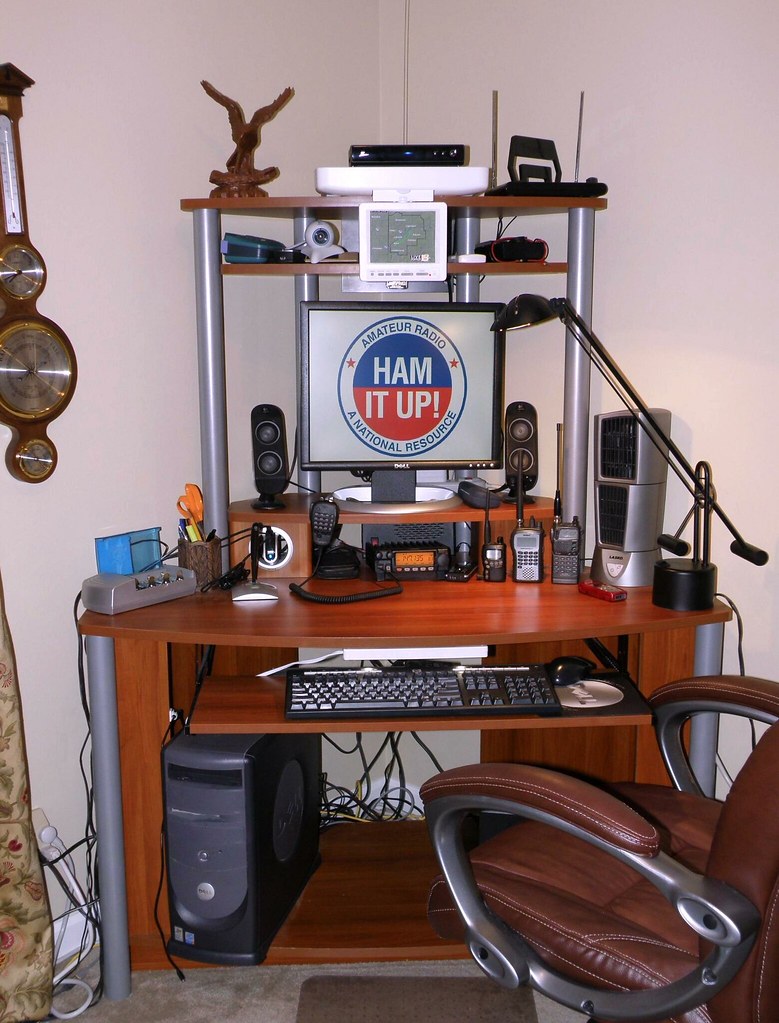
1.1 About this volume
This is the navigator for the Radios series — a per-device reference hub covering every ham handheld, HF transceiver, DMR HT, DMR hotspot, shortwave and weather receiver, CW practice device, and the CubeSatSim amateur-radio satellite simulator in the lineup. It tells you how to read the series, where to look for what, and how the per-device deep dives relate to the cross-cutting topic dives that accompany them.
Each owned radio or hotspot gets its own deep-dive folder following a standard template — hardware tour, operating modes, programming workflow, codeplug backups, field use, tips, resources. Cross-cutting topic dives cover DMR network architecture, the programming software landscape, and the frequency-planning / license envelope across all the radios in one place; a reference closeout holds the laminate-ready cheatsheets, A-Z glossary, and canonical anchor index.
This volume is the page that gets opened first. The per-device and topic dives are reached from here.
The sibling project Antennas (a peer top-level reference) is the 33-volume antenna-side reference; every TX-capable radio in this series pairs with antenna recommendations there. Don’t re-derive antenna content here; cross-link to Antennas Vol 29 (Use-case Matrix) which has explicit per-radio antenna recommendations.
1.2 The lineup at a glance
The owned radios in the lineup, organized by category. Each row points to the deep dive that covers it.
Table 1 — The lineup at a glance
| Vol | Type | Item | Bands | License tier | Posture |
|---|---|---|---|---|---|
| 2 | Ham HT (quad-band, GPS, IPX7) | Yaesu VX-8DR | 6m/2m/220 RX/70cm + wideband RX | Amateur (any) | Portable/EDC |
| 3 | Ham HT (dual-band, 8W) | Baofeng F8HP | 2m/70cm | Amateur (any) | Portable/mobile |
| 4 | Ham HT (dual-band, legacy) | Baofeng UV-B5 | 2m/70cm | Amateur (any) | Portable backup |
| 5 | DMR HT (dual-band) | AnyTone AT-D878UVII PLUS | 2m/70cm digital + analog | Amateur (any) | EDC |
| 6 | HF transceiver (portable) | Xiegu X6100 | 0.5-30 MHz + 50-54 MHz | Amateur (Gen/Ex) | Portable/POTA |
| 7 | HF/6m amplifier (100W) | Xiegu XPA125B | matches X6100 drive | Amateur (Gen/Ex) | Home / portable |
| 8 | Shortwave portable (RX) | Tecsun PL-880 | LW/MW/SW + air | No license | EDC/travel |
| 9 | Weather radio (S.A.M.E. alerting) | Midland WR120 | NOAA WX channels | No license | Home base |
| 18 | DMR hotspot — commercial appliance | SkyBridge Plus | 70cm (or 2m) | Amateur (any) | Home base |
| 19 | DMR hotspot — DIY Pi-Star/WPSD | DIY WPSD Hotspot | 70cm (or 2m) | Amateur (any) | Home base |
| 23 | CW practice generator | MFJ-419 CW Elmer | Audio | n/a | Bench |
| 23 | Electronic keyer + paddle | MFJ-422D Keyer Paddle | n/a | Amateur (any) | Bench / desk |
| 24 | SIP/VoIP phone | WiPhone | Wi-Fi (no RF radio role) | n/a | Bench drawer |
These radios, hotspots, and CW devices each get a per-device deep dive; the cross-cutting topic dives (DMR network architecture, programming software, frequency planning) and the reference closeout cover the material that spans all of them.
1.3 The decision graph — “I want to do X, which radio?”
Use this table when the question is “I want to do this, which radio?” The cross-link in the third column points to the deep dive that covers it in depth.
Table 2 — The decision graph — "I want to do X, which radio?"
| Use case | First-choice radio (with antenna note) | Deep dive |
|---|---|---|
| Monitor weather alerts (S.A.M.E. county-coded) | Midland WR120 — dedicated weather alerter; scanners can do WX but no S.A.M.E. alerting | Vol 12 |
| Operate amateur HF SSB (DX, contests, ragchew) | Xiegu X6100 standalone, or X6100 + XPA125B for 100 W out | Vol 9, Vol 10 |
| Operate amateur VHF/UHF FM (repeaters, simplex) | AnyTone D878UVII (best analog audio), Yaesu VX-8DR (rugged), Baofeng F8HP (cheap) | Vol 8, Vol 5, Vol 6 |
| Operate DMR (talkgroups, BrandMeister/TGIF) | AnyTone D878UVII direct to a repeater, or AnyTone + WPSD hotspot for any-talkgroup-anywhere | Vol 8, Vol 22, Vol 2 |
| Operate APRS (position beacons, messaging) | Yaesu VX-8DR (internal TNC + optional GPS module) | Vol 5 |
| Operate GMRS / family-channel UHF | Need a GMRS-certified radio (none in lineup); flagged as gap. Baofeng F8HP can TX into GMRS but is not Part 95 certified. | (gap) |
| Shortwave listening (SWL — broadcast, utility) | Tecsun PL-880 (premium portable); X6100 if you want SSB tuning + spectrum | Vol 11, Vol 9 |
| Field-day portable HF | Xiegu X6100 + Wolf River Coil + 30-50 W direct out (XPA125B too heavy for portable) | Vol 9 |
| Mobile DMR (vehicle) | AnyTone D878 on the belt, or BCD536HP for scanning while operating | Vol 8, Vol 15 |
| RF safety / EMC compliance check | Cross-link to Antennas Vol 31 (Regulatory & RF Safety) and Vol 27 (Spectrum Analyzers) | (Antennas) |
When two radios both fit a use case, the choice tilts on posture (handheld vs. mobile vs. base), audio quality (the AnyTone has noticeably better receive audio than the Baofeng F8HP), and feature depth.
1.4 The license envelope
The operator holds FCC Amateur Extra-class with full Part 97 privileges across all amateur bands HF through microwave, up to 1.5 kW PEP. That covers TX on every amateur radio in the lineup and the two hotspots. For everything outside the amateur bands, the table below is the operating envelope. Cross-link to the deep treatment in Vol 4 (Frequency Planning & License Envelope) and the regulatory deep dive in Antennas Vol 31.
Table 3 — The license envelope
| Service | Authorization | TX legal? | RX legal? |
|---|---|---|---|
| Amateur HF/VHF/UHF/microwave (Part 97) | Amateur Extra (held) | Yes — all bands | Yes |
| GMRS (Part 95 §95E, 462/467 MHz) | $35 GMRS license (10 yr) | Need license + certified radio | Yes |
| FRS (Part 95 §95B, 462/467 MHz) | No license | Need FRS-certified radio | Yes |
| MURS (Part 95 §95J, 151-154 MHz) | No license | Need MURS-certified radio (≤2 W) | Yes |
| CB (Part 95 §95D, 26.965-27.405 MHz) | No license | Need CB-certified radio | Yes |
| Marine VHF (Part 80, 156-162 MHz) | License (on vessel) | Vessel + license | Yes |
| Aero VHF AM (Part 87, 118-137 MHz) | Aircraft station license | No (no TX) | Yes |
| Cellular (Part 22/24/27) | Carrier-issued | Carrier only | RX is legal — but ECPA §2511 prohibits intentional intercept of certain content |
| Land Mobile Radio (Part 90, various) | Site/business license | No (no TX) | Yes |
| Public safety encrypted (P25 Phase II + encryption) | Agency only | No | RX legal where unencrypted; decrypting is illegal even passively |
The asymmetry that matters: TX needs a license; RX (in most cases) does not. Receive-only operation is lawful across almost every frequency. Where it gets nuanced is the ECPA § 2511 carve-out for cellular and encrypted communications — see Vol 4 §5 (Part 22 cellular) ↗ for the boundary.
1.5 Categorization — radios, scanners, hotspots
Three categories of device sit across the radio shack:
Radios — TX-capable transceivers. Bound by licensing for TX. The amateur radios require an amateur license for TX; the Tecsun PL-880 and Midland WR120 are receive-only despite being “radio” devices conceptually. The Yaesu VX-8DR, the Baofengs, the AnyTone, the Xiegu X6100 (and amplifier) are full transceivers.
Scanners — Receive-only by hardware and by Part 15 certification. The Uniden lineup (covered in the sibling Scanners project) spans flagship → mid → legacy. Modern scanners decode trunked digital systems (P25 Phase II most common) and analog conventional; legacy scanners are analog-only.
Hotspots — Specialized appliances that bridge a local low-power VHF/UHF DMR signal to the internet, allowing access to any BrandMeister/TGIF/W0CHP talkgroup from anywhere with internet. The SkyBridge Plus is the turnkey commercial appliance (BridgeCom Systems); the DIY WPSD hotspot is a Pi-based MMDVM build with a Nextion display, hand-assembled. Both transmit at very low power (10-20 mW) on amateur 70cm or 2m frequencies. Hotspot operation requires an amateur license; coordinate with local repeater coordinators to avoid stomping on the local repeater output.
The duality matters: a Uniden SDS100 is a scanner (RX-only); an AnyTone D878 is a radio (TX-capable). A hotspot is neither — it’s an RF transport bridge from local VHF/UHF to the internet DMR network.
1.6 The per-radio volume template
Each radio or hotspot deep dive follows this template, so once you’ve read one you know how to read the others:
1. About this volume — overview, when this radio earns the bench slot,
   posture (home/portable/mobile/handheld), license tier required for TX
2. Hardware tour — controls, display, ports, battery, size/weight, build quality
3. Operating modes — bands covered, modulations, simplex/duplex/digital
4. Programming workflow — channels, scan lists, talkgroups, CPS pipeline
   (cross-link to the programming dive for the software)
5. Codeplug backups — versioned snapshots and a recommended backup layout
6. Field use — antenna pairing (cross-link to Antennas Vol 29),
   posture, common gotchas
7. Tips & tricks — non-obvious operations, hidden menus, firmware mods
8. Resources — manuals, vendor links, community forums
The cross-cutting topic dives use adapted templates because they’re not single-device — the DMR Network Architecture dive has its own section structure focused on networks rather than hardware; the reference closeout is cheatsheets + glossary + anchor index.
1.7 Programming software landscape (preview)
A quick map of which software programs which radio. The programming dive has the deep treatment.
Table 4 — Programming software landscape (preview)
| Software | Radios it programs | OS | Cost |
|---|---|---|---|
| ProScan (Uniden CPS) | Uniden SDS100, SDS200, BCD536HP, BCD396XT | Windows | Paid (license) |
| Sentinel (Uniden CPS) | Uniden BCD436HP / BCD536HP family | Windows | Free (Uniden) |
| FreeScan (Uniden CPS alternative) | Uniden BC246T, BC346XT, BCD396XT, etc. (older) | Windows | Free |
| AnyTone CPS (D878UVII) | AnyTone AT-D878UVII PLUS | Windows | Free (vendor) |
| CHIRP | Baofeng F8HP, UV-B5, Yaesu VX-8DR, dozens of others | Windows/Mac/Linux | Free (OSS) |
| RT Systems VX-8 Programmer | Yaesu VX-8DR (alternative to CHIRP) | Windows | Paid |
| wfView | Icom radios (none in this lineup currently) — CI-V control | Windows/Mac/Linux | Free (OSS) |
| Pi-Star / WPSD web UI | DIY WPSD hotspot | Browser-based | Free (OSS) |
| BridgeCom config tool | SkyBridge Plus | Browser-based | Free (with appliance) |
The notable patterns: Uniden flagship line consolidates around ProScan + Sentinel (Windows); CHIRP is the universal cross-vendor backup that handles almost every cheap dual-band HT including the Baofengs and (sub-optimally) the Yaesu; AnyTone DMR has its own vendor CPS because the codeplug structure (talkgroups + contacts + roaming + APRS in one bundle) is too complex for CHIRP to handle well.
1.8 Posture mapping
Each radio fits one or more postures. The “best” posture isn’t always the most-used — the AnyTone D878UVII is technically a handheld but spends most of its time docked to a desktop charger in the typical operating posture.
Home base / shack:
- Xiegu X6100 + XPA125B (the HF rig)
- SkyBridge Plus + DIY WPSD hotspots (DMR network access)
- Tecsun PL-880 reading at the kitchen table (SWL)
- Midland WR120 (always-on weather alerter)
Portable / field day:
- Xiegu X6100 + portable antenna (POTA, SOTA, parks)
- AnyTone D878UVII + Wolf River Coil setup (DMR on the road)
- Tecsun PL-880 in the backpack (travel SWL)
Mobile / vehicle:
- Baofeng F8HP in the glove box (ham emergency comms)
Handheld / EDC:
- AnyTone D878UVII on the belt (daily DMR)
- Baofeng F8HP or Yaesu VX-8DR as backup HT (depending on band/use)
The bench-drawer items (the WiPhone, the MFJ CW gear) don’t have an active operating posture — they live where they live until needed.
1.9 DMR network architecture (preview)
A 30-second framing of how the hotspots fit into the DMR world. The DMR Network Architecture dive has the deep treatment.
Three big networks carry the bulk of amateur DMR traffic: BrandMeister (the largest, ~140k registered users worldwide), TGIF Network (smaller, more community-driven, easier hotspot setup), and W0CHP-PiStar-Dash (WPSD) as both a network and a Pi-Star dashboard replacement that the DIY hotspot runs. Each network has thousands of talkgroups — virtual rooms where users hang out. Some are geographic (TG 3162 = Michigan), some are special-interest (TG 91 = Worldwide English chat), some are time-slot-restricted, some are PTT-triggered (only active when someone keys up).
Repeaters are infrastructure-grade DMR devices that hams within RF range can use directly. Hotspots are personal low-power DMR devices that bridge your HT’s RF signal to the internet — they exist because most hams aren’t within range of a local DMR repeater, and even when they are, the hotspot gives access to any talkgroup on any network without the repeater operator’s gatekeeping.
The two hotspots in the lineup (SkyBridge Plus + DIY WPSD) point at the same DMR networks but give two different deployment options: turnkey (SkyBridge) vs. tinker-friendly (WPSD). Both produce essentially the same on-air experience; the difference is in configuration depth and update cadence.
1.10 Antenna pairing reference (preview)
Don’t re-derive antenna content here — every TX-capable radio in this series has its antenna recommendations in Antennas Vol 29 (Use-case Matrix), which has 17 per-radio sections with specific antenna types, BALUN/UNUN choices, feedline recommendations, and a 4-tier upgrade ladder per radio.
A quick high-traffic reference:
Table 5 — A quick high-traffic reference
| Radio | First-pick antenna upgrade |
|---|---|
| Yaesu VX-8DR / Baofeng F8HP | Nagoya NA-771 38 cm whip (~$20-25, +6 dB on 2m, +3 dB on 70cm) |
| AnyTone D878UVII | Same NA-771; the D878 stock antenna is below average |
| Xiegu X6100 | EFHW + 49:1 UNUN (HF) or Wolf River Coil portable setup |
| Tecsun PL-880 | Stock telescopic for SWL; YouLoop active loop for indoor weak-signal |
| SkyBridge Plus / DIY WPSD | 70cm rubber duck (stock); or 70cm J-pole / Slim Jim for slightly more range |
The hotspot antenna case is unusual — you want low power into a low-gain antenna since the hotspot is in the same room as your HT; high gain would just create RF problems for nearby electronics.
1.11 Cheatsheet and closeout preview
Vol 25 is the closeout — laminate-ready cheatsheet cards (DMR talkgroup quick refs, programming-cable pinouts, frequency-band reference, license-class quick chart), an A-Z glossary of radio terms used across the series, and a canonical anchor index listing every cross-deep-dive anchor that sibling deep dives can link into.
Use it as the field reference card; use the rest of the series as the bench-side deep reference.
1.12 Resources
Authoritative references:
- ARRL (Amateur Radio Relay League) — https://www.arrl.org
- FCC ULS (license lookup) — https://wireless2.fcc.gov/UlsApp/UlsSearch
- RadioReference (frequency database, scanner programming source-of-truth) — https://www.radioreference.com
DMR network operators:
- BrandMeister — https://brandmeister.network
- TGIF Network — https://tgif.network
- W0CHP-PiStar-Dash (WPSD) — https://w0chp.radio
- RadioID.net (DMR ID assignment + database) — https://radioid.net
Vendor sites (each radio’s resources section links to the specific product page):
- Yaesu — https://www.yaesu.com
- Baofeng — https://baofengtech.com
- AnyTone (BridgeCom is US importer) — https://www.bridgecomsystems.com
- Xiegu — https://www.xiegu.eu (EU distributor; US import via Radioddity)
- Tecsun — https://www.tecsunradios.com.au (or Anon-Co)
- Midland — https://midlandusa.com
- BridgeCom Systems (SkyBridge Plus) — https://www.bridgecomsystems.com
Sibling project cross-references (load-bearing — read these alongside this series):
- Antennas — 33-volume antenna deep dive
- Antennas Vol 29 (Use-case Matrix per radio)
- Antennas Vol 31 (Regulatory & RF Safety) — deep regulatory treatment
- Hack Tools comparison.md — cross-tool decision matrix
- Hack Tools/_shared/legal_ethics.md — project-wide legal/ethics baseline (applies here equally)
Comments (0)