Yaesu VX-8DR · Volume 1
Yaesu VX-8DR — Vol 1: Introduction & Hardware
Quad-band ham handheld with GPS, APRS, and submersible IPX7 chassis
1.1 About this volume
The Yaesu VX-8DR is the quad-band amateur handheld that earned a niche the moment Yaesu released it (~2008) and never gave it back: a genuinely rugged, IPX7-submersible HT with native APRS, an internal TNC, an optional clip-on GPS module (the FGPS-2), and dual-receive capable of true cross-band repeat. It is discontinued — Yaesu’s current handheld line is the FT-3D / FT-5D — but it has aged so well, and its specific feature combination is sufficiently uncommon in the modern Yaesu lineup, that the used market for VX-8 series radios remains active and the radio still earns its bench slot in mid-2026.
The reason it earns the slot, for the kind of operating this bench does, is the combination of three things no current production handheld replicates cleanly: (a) IPX7 submersible rating in a physically small package — 1 m of submersion for 30 minutes, properly sealed antenna jack, properly gasketed battery interface; (b) internal AX.25 TNC supporting both 1200 baud and 9600 baud APRS without an external KISS modem or audio cable, including digipeating and smart-beaconing; and (c) genuine dual-receive on independent VFOs, capable of cross-band repeat in all four directions (V/V, U/U, V/U, U/V), without the dual-receive being a marketing-speak time-slice of a single front end. The FT-3D and FT-5D supersede it on display resolution, on C4FM digital voice, and on touchscreen ergonomics — but they trade the IPX7 envelope (the FT-3D is IPX5, splash-resistant only) and the dual-receive on the VX-8DR’s terms is arguably more honest than the FT-5D’s narrowband dual-RX implementation.
Against the rest of the handheld lineup (Vol 6 Baofeng F8HP, Vol 7 Baofeng UV-B5, Vol 8 AnyTone D878UVII), the VX-8DR is the “throw it in the kayak” rig. The Baofengs are disposable in a way that lets you not care if one disappears; the AnyTone is the daily-driver DMR HT with the best receive audio; the VX-8DR is the rig that goes outdoors when “outdoors” means rain, surf, or a creek crossing. It is also the only one of the four that does APRS without an external setup — which makes it the natural choice for any trip where position-beaconing matters more than digital voice. Cross-link: see Vol 1 §3 (decision graph) ↗ for the per-use-case picks, and Vol 1 §8 (posture mapping) ↗ for where this radio sits in the daily rotation.
A note on naming. Three radios in the Yaesu VX-8 family ship under similar designations and they are not interchangeable: the VX-8R (the original 2008 release, quad-band, no internal GPS support — the FGPS-1 was the contemporary GPS accessory and is a different physical module), the VX-8DR (the subject here — quad-band, APRS-capable, supports the FGPS-2 clip-on GPS), and the VX-8GR (tri-band, no 6 m, but ships with the GPS module built into the radio body rather than as a clip-on). The VX-8GR is the one to look for if you want GPS without the clip-on lump; the VX-8DR is the one to look for if you want 6 m TX. Used-market listings sometimes conflate the three — confirm the model designation on the radio’s bottom label before buying, and confirm the bundled accessories (FGPS-2 is typically a separate $40-60 line item in mid-2026 on the used market).
1.2 Hardware tour
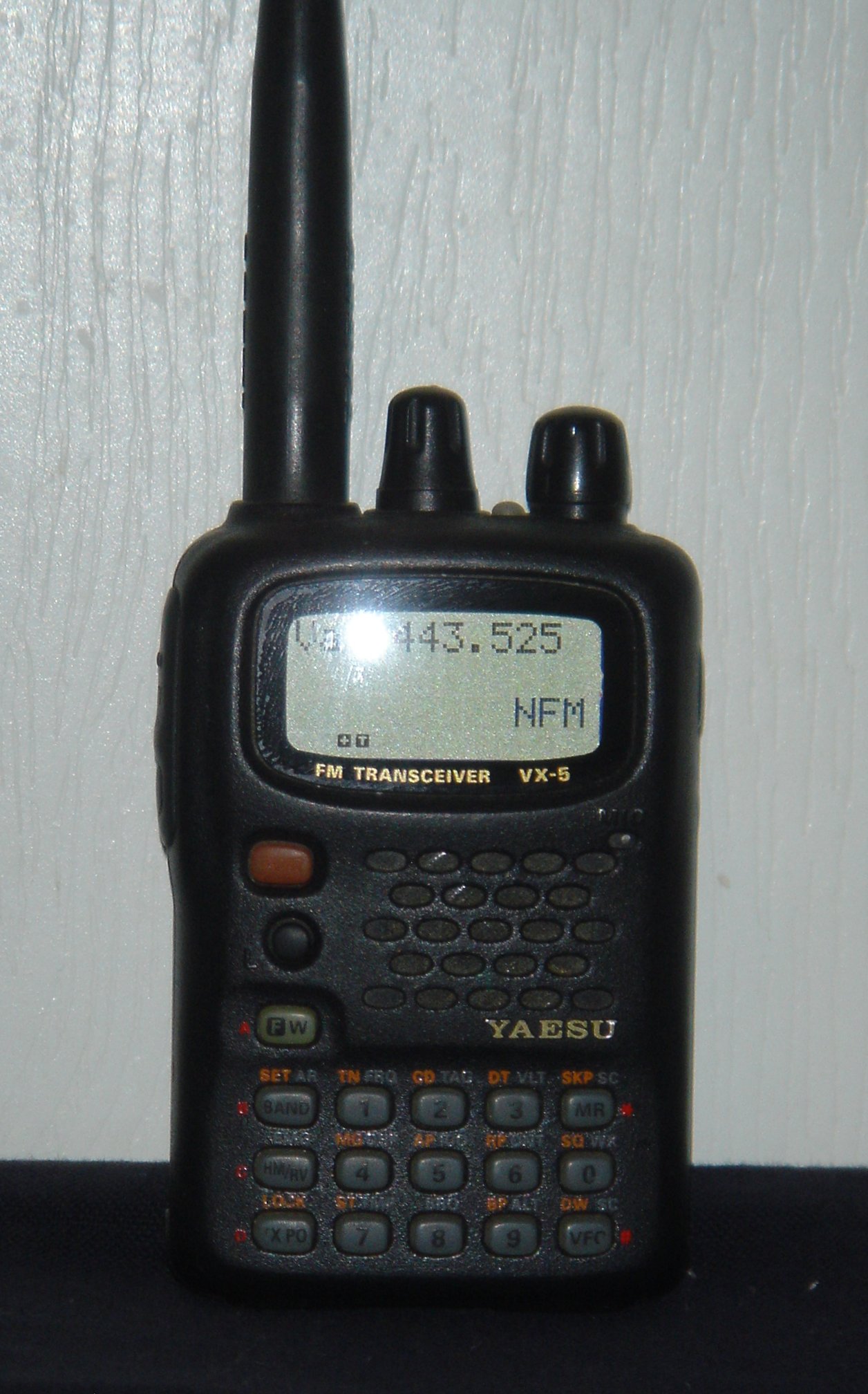
The physical envelope: roughly 60 × 95 × 23 mm (excluding the antenna and rear battery hump), about 225 g with the stock FNB-101LI battery installed and stock rubber-duck antenna. The chassis is die-cast magnesium under the rubberized outer shell, which is the structural reason the IPX7 rating holds up after years of field use — the gaskets seat against rigid metal, not flexing plastic. The form factor is taller-than-wide, with the front face dominated by the 1.7”-class transflective TFT color display (240 × 180 pixels approximate, TBD — verify against the spec sheet) and a 16-key keypad below it.
Controls. The top deck carries two concentric rotary knobs — the outer is the main VFO encoder for the primary receiver (Band A), the inner is the volume control for Band A. The right side of the radio has a second VFO encoder dedicated to Band B (the secondary receiver), with a small concentric volume control. This is unusual — most dual-receive HTs share a single VFO knob and require a band-select press to retune the secondary receiver. The VX-8DR’s dedicated B-VFO knob is one of the ergonomic decisions that makes APRS-while-monitoring-a-repeater natural: tune Band A to the repeater, tune Band B to 144.390, leave them both running.
The left side carries the PTT (primary) at the natural thumb-rest position, with a second PTT button below it for cross-band repeat keying. The “Set/Menu,” “Mode,” and “Power” buttons cluster around the keypad. A rotary squelch control is integrated with the volume knobs (push-to-set on the outer A-volume knob brings up the squelch slider in the display).
Display. Transflective TFT color, day/night auto-brightness controlled by an ambient light sensor on the top edge. The “transflective” part matters: it stays readable in direct sunlight because ambient light reflects off the rear of the LCD back through the panel, the same trick that makes color e-paper marine GPS units readable on a sunny deck. In a dark room with the backlight off, the display is essentially unreadable — but turn the backlight on (one tap of the lamp button) and it lights up to a high enough brightness for night-vehicle use without being painful. The auto-brightness has three settings (off, two intensity levels) plus a manual override; the off-setting kills the backlight entirely for battery conservation during APRS-only operation, which extends runtime by 15-20% in informal field measurements.
Antenna jack. Top-mounted SMA-female. The gender is the standard Yaesu HT convention (matches the FT-60, FT-65, FT-3D, FT-5D, VX-6, VX-7) and means an off-the-shelf Diamond SRH77CA or NA-771-style 38 cm whip drops in without an adapter. The SMA connector itself is seated through an O-ring at the chassis penetration; the O-ring is the IPX7 seal at the antenna joint. After several years of heavy use the O-ring can compress and lose its seal — Yaesu sells replacement seal kits, or any -011 nitrile O-ring of equivalent diameter substitutes adequately. Inspect annually if the radio sees salt water; replace if compressed flat or visibly deformed.
Battery. Stock is the FNB-101LI — 7.4 V nominal Li-ion, 1100 mAh, slides onto the back of the radio and locks with a sliding latch. Two alternative trays exist: the FBA-39 AA-tray holds 5× AA cells (alkaline or NiMH) in series for 7.5 V nominal at AA capacity, and the FBA-23 (older variant) is similar. The AA-tray is the field-recovery option — when the Li-ion is dead and you’re 20 miles from a wall outlet, five AAs from the gas station get you back on the air. Runtime on the FNB-101LI is roughly 6-8 hours at moderate duty cycle with the GPS engaged and APRS running on a 2-minute beacon interval; pure RX-only listening pushes it to 12-15 hours; transmit-heavy (continuous PTT) operation drops it to 2-3 hours. The battery contacts on the radio body are gold-plated brass pads recessed into a small gasketed well — the IPX7 rating holds with the battery attached and the battery latch fully engaged, but does not hold with the battery removed (the contacts are exposed).
Mic/speaker/data jack. A 4-pin proprietary connector on the right side of the radio, under a rubber dust cap. The connector is the Yaesu standard for the VX-series (also used on the VX-6R, VX-7R, and FT-1D/2D/3D, but not compatible with the older FT-60 or modern FT-5D which use a different pinout). It carries: speaker audio out, microphone audio in, PTT, and serial data (TX/RX at TTL levels). The data lines are what the programming cable (RT Systems USB-59) and the CT-134 radio-to-radio clone cable use; the audio + PTT lines are what the MH-74A7A speaker-microphone uses. There is no audio-out tap suitable for external TNCs — the internal TNC handles all APRS work, and external KISS modems aren’t supported through this connector.
Optional FGPS-2 GPS module. The FGPS-2 is a clip-on accessory that mounts on top of the radio in place of (or alongside, depending on accessory configuration) the standard top cap. It includes its own patch antenna, an integrated GPS receiver (a SiRFstarIII or equivalent generation chipset — TBD verify), and a short pigtail that plugs into a dedicated connector under a removable top-deck cover. Mounted, it adds about 25 mm to the top of the radio. Cold-start lock is 1-3 minutes outdoors with a clear sky view; warm restart (within an hour, GPS almanac still cached) is sub-30 seconds; lock indoors near a window is achievable but slow (2-5 minutes); lock indoors away from windows is generally not possible — the patch antenna is small and the radio’s metal body provides too much shadowing. Used-market FGPS-2 modules typically run $40-60 in mid-2026, often bundled with a used VX-8DR for $20-30 less than the sum of separate prices.
Submersibility. IPX7 per Yaesu’s spec — 1 meter for 30 minutes. The radio has been informally field-tested by many operators well past spec (multiple eHam reviews note immersion to 1.5-2 m for several hours with no ingress) but Yaesu’s published rating is the contractual envelope. Rinse with fresh water after any salt-water exposure; the chassis withstands salt but the antenna O-ring and the battery latch gasket degrade faster in marine environments and warrant a closer-than-annual inspection cadence. The IPX7 rating depends on every gasket being seated — antenna, battery latch, mic/data jack cap, and the top-deck GPS-connector cover (or the FGPS-2 mounted in its place). A missing or twisted mic-jack cap is the most common IPX7-defeating user error.
Comments (0)