WiPhone · Volume 4
WiPhone — Vol 4: Reference
Open-hardware ESP32-based SIP/VoIP phone
4.1 Use case fit (why it lives in the bench drawer)
This is the section where the honesty matters. The WiPhone is not first-pick for anything in normal use. The cellular phone in your pocket is the first-pick for “phone.” Any radio in this lineup (Vols 5-22) is first-pick for “radio.” The WiPhone earns the bench drawer slot in three specific contexts and no others.
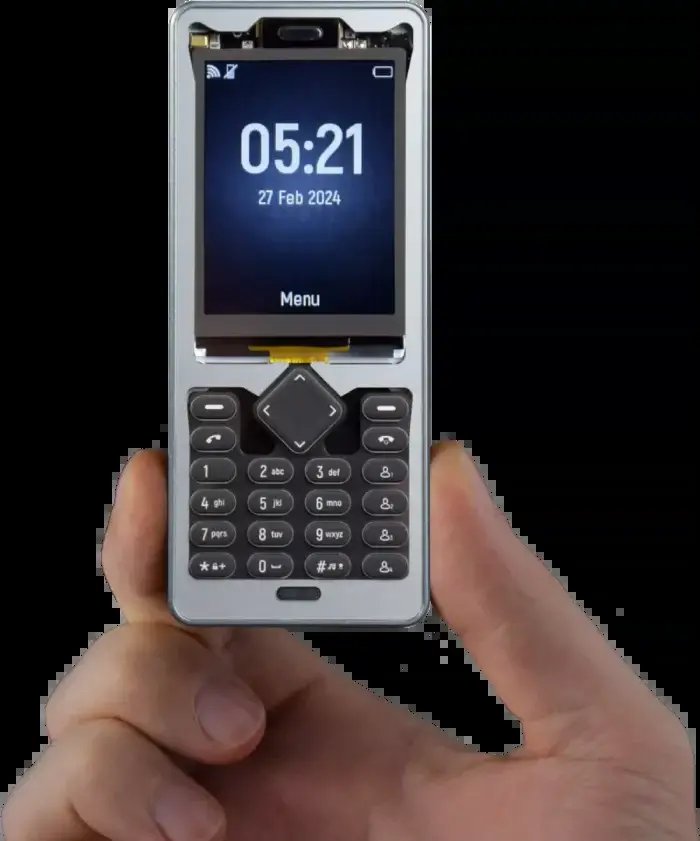
Context 1: Travel SIP-phone backup with no cellular dependency. When the cellular network is unavailable (international travel without roaming, a remote site with only Wi-Fi connectivity, a deliberately cellular-off posture for OPSEC reasons), the WiPhone gives you a working phone over whatever Wi-Fi is available. Register against a personal SIP account (a $1.50/month VoIP.ms DID, an Asterisk box at home, etc.) and you have inbound calls on your usual DID and outbound calls to anywhere. The handset form factor — real keypad, real earpiece, real microphone — is more usable than a softphone app on a laptop. The Wi-Fi-only dependency is also the limitation: no Wi-Fi, no phone. For most travel, this is a niche case (cellular roaming is cheap now); for specific postures it’s the right tool.
Context 2: Hackable phone form-factor for development experiments. When the project on the bench is “I want to add X to a phone” — where X is a sensor, a new codec, a different display, a custom call-routing UI, a Meshtastic bridge — the WiPhone is the only programmable open-hardware phone-shaped ESP32 device that exists. Every commercial SIP desk phone is closed firmware; every hobbyist softphone is on a laptop or a touchscreen, not a real phone keypad. The daughter-board connector (§4) plus open firmware (§6) makes the WiPhone the right base for any project where “phone form factor with a keypad and a speaker and a microphone” matters. Examples: a Meshtastic+SIP combo node; an emergency-services SIP terminal with a custom one-touch dial; a SIP phone that also reads NFC employee badges for in-call identification.
Context 3: ESP32 / SIP / VoIP learning platform. When the goal is to understand the SIP protocol, the RTP media path, the codec selection logic, NAT traversal, or the ESP32’s Wi-Fi+audio capabilities, the WiPhone is a working reference implementation you can read, modify, rebuild, and observe. The firmware repo is the curriculum. Wireshark the SIP exchange on your local network and read the firmware source side-by-side; you learn the protocol in a way that no closed appliance allows.
What it isn’t first-pick for:
- Daily-driver phone — the cellular phone wins on every axis (cellular reach, battery life, app ecosystem, audio quality, build polish).
- Amateur radio voice — the AnyTone D878UVII, Yaesu VX-8DR, or Baofeng F8HP wins. The WiPhone has no RF radio role.
- DMR talkgroups — the AnyTone + a hotspot wins. The WiPhone doesn’t speak DMR.
- Scanner / monitoring — any Uniden in Vols 13-20 wins. The WiPhone is a TX/RX endpoint, not a wideband receiver.
- Field-day comms — any of the HF or VHF/UHF radios wins. The WiPhone needs Wi-Fi + internet to do anything.
- OPSEC-sensitive comms — neither the WiPhone nor the cellular phone is the right tool for sensitive comms (SIP over open Wi-Fi is plaintext SIP signalling and unencrypted RTP unless SRTP is configured; even with TLS-SIP and SRTP, your SIP provider sees metadata; even self-hosted Asterisk leaves a metadata trail). For sensitive comms see the operational-posture treatment in
../../../Hack Tools/_shared/legal_ethics.mdand the broader posture discussion in../../../Hack Tools/Hacker Tradecraft/.
Posture in the bench drawer. It lives in the drawer. When the project is one of the three contexts above, it comes out. When the project is anything else, it stays in the drawer. Charge it occasionally; check the firmware version annually; redo the SIP-account setup if your VoIP provider changes their server endpoints. This is appropriate posture for a niche tool that’s nice-to-have — not a tool that’s in active rotation.
The cross-reference in Vol 1 §8 (Posture mapping) ↗ places the WiPhone in the “bench drawer items — no active posture” bucket alongside the test gear in Vol 23. Both are correct categorizations.
4.2 Firmware and software on this site
The WiPhone vendor has never linked its firmware files from its downloads page; the site archives every vendor build found on the vendor’s update server, the two published source releases and the Arduino core, each with a README covering OTA and USB flashing, at https://radios.fubsypoly.com/downloads/#wiphone. The binaries are application images only (address 0x10000).
Table 1 — Firmware and software on this site
| Product | Recommended release |
|---|---|
| WiPhone firmware | 0.8.32 — the version the vendor’s OTA server offers |
| WiPhone firmware source (Arduino sketch) | 0.8.30 — newest published source |
| WiPhone Arduino core | 0.1.2 |
4.3 Resources
Vendor documentation (the manuals folder is the load-bearing reference for any factual claim about this device):
../manuals/wiphone/Overview — v0.4rc1 documentation.pdf— high-level device tour../manuals/wiphone/Technical Details — v0.4rc1 documentation.pdf— hardware deep dive (pin numbers, voltage rails, peripheral assignments) — the most useful PDF for any daughter-board work../manuals/wiphone/Setting up SIP Accounts — v0.4rc1 documentation.pdf— SIP-account configuration walkthrough../manuals/wiphone/Calls and Messages — v0.4rc1 documentation.pdf— end-user call workflow../manuals/wiphone/Charge the battery — v0.4rc1 documentation.pdf— battery + charging procedure../manuals/wiphone/Firmware Updates — v0.4rc1 documentation.pdf— OTA + USB update procedure../manuals/wiphone/Daughter Board Design Guide — v0.4rc1 documentation.pdf— daughter-board pinout + mechanical envelope + design rules
Vendor and product:
- WiPhone product page (HackEDA): https://www.wiphone.io
- WiPhone official GitHub organisation: https://github.com/ESP32-WiPhone (its
wiphone-firmwarerepository is an empty placeholder; the firmware source ships as vendor zips) - The repositories cited in earlier write-ups (
HackEDA/wiphone-firmware,Hong-Kong-Districts-Info/wiphone-firmware,HackEDA/wiphone-hardware,wiphone/wiphone-hardware) no longer exist (404, September 2026)
SIP providers (the WiPhone’s “back end” — pick one or self-host):
- VoIP.ms — https://voip.ms — the default recommendation; $1.50/month DID + per-minute or flat-rate plans
- Twilio Programmable Voice — https://www.twilio.com/voice — SIP-capable; pay-as-you-go pricing
- OnSIP — https://www.onsip.com — free SIP-to-SIP within OnSIP, paid for PSTN
- JMP.chat (SIP-to-XMPP bridge) — https://jmp.chat
- Asterisk (self-hosted PBX) — https://www.asterisk.org
- FreePBX (Asterisk with a GUI) — https://www.freepbx.org
ESP32 development toolchain (required for any firmware modification):
- Arduino IDE — https://www.arduino.cc/en/software — with the WiPhone Arduino core from the vendor’s Boards Manager index (the firmware is an Arduino sketch, not an ESP-IDF project)
- Espressif Flash Download Tool (the vendor-documented binary flasher) — https://www.espressif.com/en/support/download/other-tools
- esptool.py (command-line alternative) — https://github.com/espressif/esptool
Protocol references:
- SIP — IETF RFC 3261 — https://www.rfc-editor.org/rfc/rfc3261
- RTP — IETF RFC 3550 — https://www.rfc-editor.org/rfc/rfc3550
- SRTP — IETF RFC 3711 — https://www.rfc-editor.org/rfc/rfc3711
- G.711 codec — ITU-T G.711 — https://www.itu.int/rec/T-REC-G.711
Sibling cross-references in this series:
- Vol 1 (Overview) §2 (lineup-at-a-glance) ↗ — where the WiPhone sits in the 25-volume map
- Vol 1 §5 (Categorization) ↗ — radios vs scanners vs hotspots; WiPhone as the lone “radio-adjacent” entry
- Vol 1 §8 (Posture mapping) ↗ — bench-drawer posture
Sibling project cross-references (minimal — this device has no RF radio role):
- Antennas Vol 1 (Overview) — for the “internal Wi-Fi antenna is enough; no external RF necessary” framing that applies to the WiPhone (and to every other 2.4 GHz Wi-Fi consumer device in the hub)
- Hack Tools/_shared/legal_ethics.md — applies to SIP signalling metadata posture as much as to RF
- Hack Tools/Hacker Tradecraft — broader posture and tradecraft discussion if the WiPhone is being deployed in a tradecraft context rather than a casual one
Comments (0)