Xiegu X6100 · Volume 2
Xiegu X6100 — Vol 2: Operations
HF/6m with built-in tuner, color touchscreen, internal battery
2.1 Operating modes
2.1.1 Bands and modes
Table 1 — Bands and modes
| Band | Range (MHz) | Modes supported |
|---|---|---|
| 160 m | 1.8 – 2.0 | LSB, CW, AM, RTTY/DIG |
| 80 m | 3.5 – 4.0 | LSB, CW, AM, RTTY/DIG |
| 60 m | 5.330 – 5.405 ch. | USB only (channelized — Part 97 §97.303(h)) |
| 40 m | 7.0 – 7.3 | LSB, CW, AM, RTTY/DIG |
| 30 m | 10.1 – 10.15 | CW, RTTY/DIG (no voice — Part 97) |
| 20 m | 14.0 – 14.35 | USB, CW, AM, RTTY/DIG |
| 17 m | 18.068 – 18.168 | USB, CW, RTTY/DIG |
| 15 m | 21.0 – 21.45 | USB, CW, AM, RTTY/DIG |
| 12 m | 24.890 – 24.990 | USB, CW, RTTY/DIG |
| 10 m | 28.0 – 29.7 | USB, CW, AM, FM (29.5+), RTTY/DIG |
| 6 m | 50.0 – 54.0 | USB, CW, AM, FM, RTTY/DIG |
| General RX | 0.5 – 30 + 50 – 54 | LSB/USB/CW/AM/FM/RTTY/DIG |
The general-RX coverage opens up SWL on shortwave broadcast bands, 60 m broadcast / utility monitoring, longwave (where useful — mostly NDB beacons at 200-415 kHz), and the entire amateur HF allocation. AM filter bandwidth is selectable up to 6 kHz which is enough for reasonable broadcast audio quality on the strong international SW stations. SSB tuning steps as fine as 1 Hz make it usable as a CW skimmer / weak-signal monitor; AM steps 1 kHz / 9 kHz / 10 kHz match international broadcast band plans.
2.1.2 The DSP and filter chain
The X6100’s filter selection is software-defined, set per mode:
- CW — 50, 100, 250, 500, 1000 Hz bandwidth, centered on a selectable BFO offset (default 700 Hz)
- SSB — 1.8, 2.4, 2.7, 3.0 kHz (and a wide-open 6 kHz option for ESSB)
- AM — 3.0, 4.0, 6.0 kHz
- FM — 12 kHz (narrowband, the standard 10 m FM bandwidth) and 25 kHz (wide, for AM broadcast that’s been re-modulated to FM)
- RTTY / DIG — 250 Hz to 3 kHz, application-dependent
The filter selection happens in the DSP after a wider analog roofing filter, so the rig’s adjacent-channel rejection is limited not by the analog roofing but by the SDR’s dynamic range — about 80-90 dB at HF, less at 6 m. This is fine for typical operating (a strong adjacent signal on the same band 20 kHz away is filtered cleanly) but breaks down when an extremely strong signal (e.g. a kilowatt station 1 km away on the next-band-up) overwhelms the front end. This is the front-end overload phenomenon mentioned in §1.
2.1.3 Waterfall display
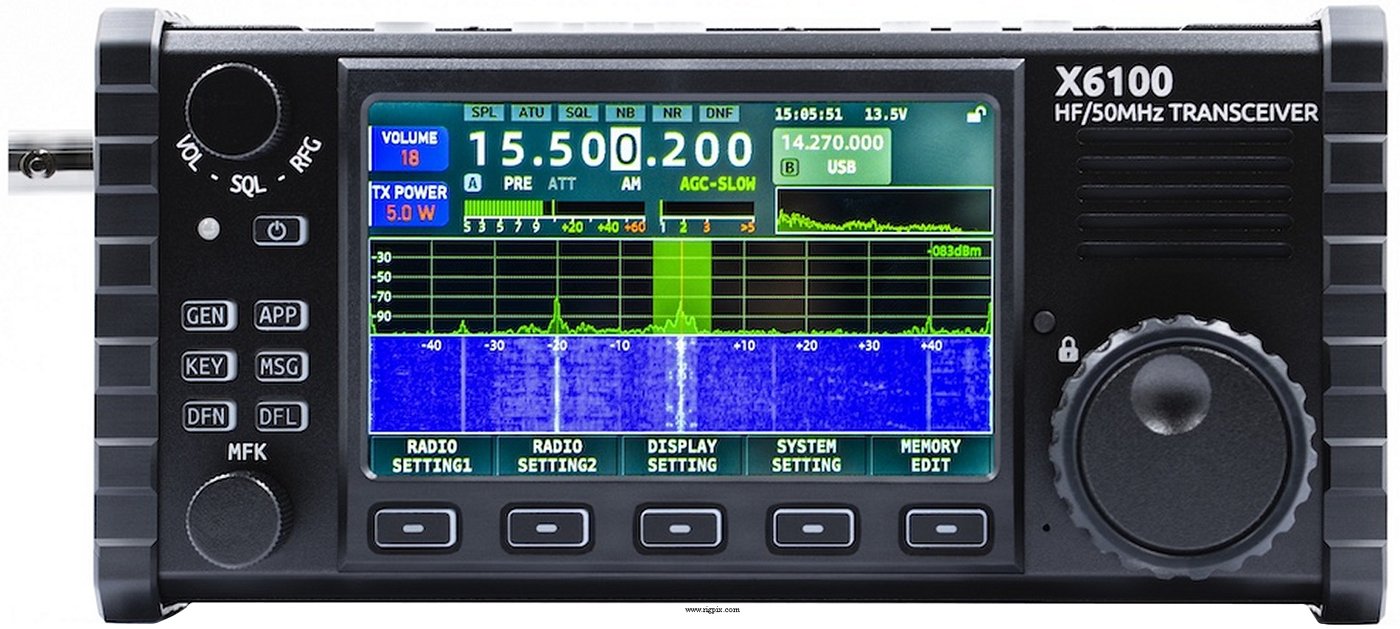
The waterfall is the X6100’s signature feature. The display shows roughly 30 kHz of spectrum centered on the current VFO frequency, with a frequency-vs-time waterfall scrolling downward. Spectrum resolution is approximately 30 Hz/bin, refresh rate ~10 fps. The waterfall is useful for:
- Finding active SSB signals without tuning — they appear as ~3 kHz wide bright bars
- Spotting CW activity as narrow vertical lines at constant frequency
- Recognizing digital modes by their distinctive signatures (FT8 = narrow tone pairs around 1500 Hz offset, PSK31 = paired sidebands, RTTY = two-tone “railroad tracks”)
- Detecting band openings by watching the noise floor and signal count change over minutes
Touch the waterfall to tune — single-tap moves the VFO to the touched frequency. The touch is responsive but coarse — fine tuning still requires the main knob.
2.1.4 VFO and memory operations
VFO A and VFO B are independent — each remembers its own frequency, mode, filter, and tuner state. Split operation (TX on VFO B, RX on VFO A) is enabled via the menu and is essential for working DX on split frequencies.
Memory channels — 99 user channels in stock firmware, plus a separate set of band-specific “memory pads” for quickly storing band-segment defaults. Each memory channel stores frequency, mode, filter, CTCSS/DCS (for FM operation), and a free-form alphanumeric tag. Memory programming is via touchscreen or via CAT software (see §4).
2.1.5 What the X6100 lacks
Honest accounting of features the X6100 does not have:
- No D-STAR — the IC-705 has D-STAR; the X6100 does not.
- No built-in GPS — unlike the FT-818 or IC-705’s optional GPS, the X6100 has no GPS module. APRS via TX is not natively supported.
- No internal sound-card-style audio recording in stock firmware — for RX recording during a contest or for QSO archiving, you record on the host PC over USB-C. (Community firmware adds this.)
- No internal CW decoder display in stock firmware (community firmware adds this).
- No band-stack-register concept the way Elecraft K-line or the better Yaesu rigs implement it — each band remembers a single last-used frequency, not a stack of recent ones.
- No CW message memory (in stock firmware).
- No 2 m / 70 cm coverage — the X6100 is HF + 6 m. For 2 m FM repeater work, reach for the AnyTone D878 ↗ or VX-8DR ↗.
- No internal antenna selection — it has one HF antenna jack. If you have multiple HF antennas (e.g. a vertical and a dipole), you switch externally.
Most of these are reasonable omissions for a $700 portable rig; some (the lack of band-stack registers, the absence of CW message memories in stock firmware) are firmware-side problems that the community has solved.
2.2 Field use
2.2.1 The portable-HF posture
The X6100 is designed for portable HF — POTA, SOTA, parks-on-the-air, field day. The integration of battery + tuner + display means a typical deployment is just the radio + antenna + a length of feedline.
A minimum-viable POTA kit:
- Xiegu X6100 (radio, internal battery)
- 41 ft (or 65 ft, or 130 ft — see §6.3) of insulated wire as an EFHW
- 49:1 UNUN at the wire’s near-end (the radio’s BNC connects through ~10 ft of RG-58 to the UNUN, then to the wire)
- Counterpoise: 17 ft of wire on the ground (optional but improves match)
- Bag, throwing line, tree
- Logbook (or laptop running WSJT-X / N1MM / fldigi connected via USB-C)
Total weight: ~3-4 lb / 1.5-2 kg. Fits in a small daypack. Deployment time once you’ve picked your tree: 5-10 minutes.
2.2.2 Antenna pairing — the big two patterns
Two antenna setups dominate X6100 portable use:
Pattern A — EFHW (End-Fed Half-Wave) + 49:1 UNUN. The EFHW is the workhorse portable HF antenna: a single wire cut to a half-wavelength on the lowest band of interest, fed at one end through a 49:1 transformer that drops the very-high feedpoint impedance (~2,500-3,000 Ω) to the radio’s 50 Ω. Naturally multi-band because the half-wave on 40 m is also a full wave on 20 m, 1.5 wavelengths on 15 m, 2 wavelengths on 10 m — all of which present similarly high (and similarly transformable) impedance. Standard lengths:
Table 2 — Pattern A — EFHW (End-Fed Half-Wave) + 49:1 UNUN. The EFHW is the workhorse portable HF antenna: a single wire cut to a half-wavelength on the lowest band of interest, fed at one end through a 49:1 transformer that drops the very-high feedpoint impedance (~2,500-3,000 Ω) to the radio's 50 Ω. Naturally multi-band because the half-wave on 40 m is also a full wave on 20 m, 1.5 wavelengths on 15 m, 2 wavelengths on 10 m — all of which present similarly high (and similarly transformable) impedance. Standard lengths
| Wire length | Lowest band | Other bands resonant on harmonics |
|---|---|---|
| 33 ft (10 m) | 20 m | 15 m, 10 m, 6 m |
| 41 ft (12.5 m) | 17 m / 20 m | 12 m, 15 m, 10 m, 6 m |
| 66 ft (20 m) | 40 m | 20 m, 17 m (partial), 15 m, 10 m |
| 132 ft (40 m) | 80 m | 40 m, 30 m (partial), 20 m, 15 m, 10 m, 6 m |
The 41 ft and 66 ft variants are the most popular portable lengths — short enough to deploy easily in a tree, broad enough band coverage. The X6100’s internal tuner handles the residual mismatch on the non-harmonic bands (notably 30 m and 17 m, where the EFHW’s harmonic relationships don’t quite line up). Detailed coverage in Antennas Vol 10 (Random-wire and end-fed).
Pattern B — Wolf River Coil + telescoping whip. The WRC is a tunable coil-based vertical: a coil sits on a tripod (or magmount, or ground spike), a telescoping whip plugs into the top, and you tune the coil’s tap to match the band of interest. Single-band-at-a-time, but small footprint, no trees needed, and gives a reasonable signal on the band you’ve tuned. Variants:
Table 3 — Pattern B — Wolf River Coil + telescoping whip. The WRC is a tunable coil-based vertical: a coil sits on a tripod (or magmount, or ground spike), a telescoping whip plugs into the top, and you tune the coil's tap to match the band of interest. Single-band-at-a-time, but small footprint, no trees needed, and gives a reasonable signal on the band you've tuned. Variants
| WRC model | Coil + base | Suitable bands | Weight |
|---|---|---|---|
| Silver Bullet 1000 (basic) | Coil + 17 ft whip | 40 / 30 / 20 / 17 / 15 / 12 / 10 m | ~3 lb / 1.4 kg |
| Silver Bullet 1000 TIA (Take-It-Along) | Coil + 17 ft whip + carbon-fiber tripod | Same as above, but lighter | ~3.5 lb / 1.6 kg |
| Silver Bullet 1000 + 80 m extension coil | Adds 80 m coverage | 80 / 40 / 30 / 20 / 17 / 15 / 12 / 10 m | ~4 lb / 1.8 kg |
WRC tuning is by manually moving an alligator clip on the coil to find the band sweet spot (then the X6100’s internal tuner cleans up the last 1.5:1 or so). With practice, band-changing takes 30-60 seconds. The Hack Tools antenna deep dive covers this in Vol 9 (Portable & mobile monopoles).
2.2.3 Antenna selection guide for portable use
Table 4 — Antenna selection guide for portable use
| Use case | Antenna recommendation |
|---|---|
| One-band POTA activation (e.g. just 20 m) | Resonant 1/2-wave dipole, fed center, simple |
| Multi-band POTA (any of 40 / 20 / 15 / 10) | EFHW 41 ft or 66 ft with 49:1 UNUN |
| Multi-band POTA including 80 m | EFHW 132 ft (needs a long deployment area) or doublet |
| Parking-lot / no-tree operating | Wolf River Coil + tripod |
| Mountain summit / SOTA | EFHW 41 ft (lightest), or WRC for fast band switching |
| Casual backyard from a fixed installation | Resonant dipole hung in trees |
The X6100’s internal tuner makes it forgiving — a 5-10% mismatch on a portable antenna is recoverable. The internal tuner cannot fix a 20:1 mismatch (e.g. a 17 ft whip on 80 m without loading), but for almost any reasonable portable antenna on the right band, the tuner gets you to <1.5:1.
2.2.4 Posture and operational notes
At the operating site:
- Deploy antenna first, before powering on the radio. (If the X6100 keys up into a disconnected antenna, no damage, but no contacts either.)
- Power on, let the radio settle for ~30 seconds (the embedded Linux takes time to fully come up).
- Set frequency and mode for the band of interest.
- Run the ATU cycle (Menu → Tune, or assign a soft key) — listen for the relay clicks, watch the SWR meter, expect 8-15 seconds for first tune on a new antenna.
- If the tuner reports failure: the antenna is probably resonating far from where you expect. Try a different band, or shorten/lengthen the wire by a few feet, or add a counterpoise.
- Once tuned, begin operating. The ATU’s match is now remembered per-band; subsequent re-tunes on the same band/antenna combination are <2 seconds.
Power budget for a typical 4-hour POTA activation:
- Estimated 50/50 RX/TX duty cycle at 5 W = roughly 1.5-2 A draw from internal battery
- Internal battery ~3 Ah → ~1.5-2 hours of operating before recharge needed
- For full-day operations: bring an external 12 V LiFePO4 battery (Bioenno 12 V 6 Ah weighs ~2 lb / 0.9 kg, gives ~6-8 additional operating hours)
- For multi-day: a small folding solar panel (Renogy 30 W or similar) can keep the battery topped off during daylight
Common gotchas in portable use:
- The X6100’s BNC connector is at the right side of the case, low to the ground when the radio sits on a picnic table. A right-angle BNC adapter keeps the feedline routing tidy and protects the connector from sideways stress.
- The touchscreen is glove-incompatible (capacitive) — in cold-weather field operations, you’ll need to remove gloves to operate, or carry a stylus.
- The radio’s plastic body is not waterproof. A light drizzle is fine; rain requires a tarp or a dry bag. Heavy moisture into the SD card slot or USB-C port will corrode contacts.
- The display is legible but washed-out in direct sunlight. A simple shade (a hat brim, a piece of cardboard) makes a big difference.
2.2.5 Shack / home use
For shack use, the X6100 becomes the HF front-end for the matching Xiegu XPA125B 100 W amplifier ↗. The pairing is:
- X6100 (5-10 W drive) → XPA125B (100 W output) → tuner/filter → antenna
- ALC feedback wire from XPA125B to X6100’s external ALC pin (the X6100 doesn’t expose this directly — a workaround is to set the X6100’s max output to ~7-8 W to safely drive the amp without overdriving)
- Power for both: a single 13.8 V, 25 A supply (the XPA125B is the power-hungry component; the X6100 draws <3 A peak)
The shack-use antenna recommendation is fundamentally different from portable — a permanent outdoor antenna (Antennas Vol 8 (Fixed verticals) or Vol 6 (Single-band dipoles) for resonant cuts, Vol 7 (Multi-band dipoles) for OCFD/G5RV/doublet). The X6100’s internal tuner handles minor mismatches; for severe mismatches at higher power (the amp out), an external tuner is required. See Antennas Vol 17 (Antenna tuners).
2.2.6 Cross-link to per-radio antenna matrix
For the full per-radio antenna recommendations, see Antennas Vol 29 (Use-case matrix). The X6100’s row in that matrix lists native characteristics (50 Ω BNC, internal tuner, 5 W direct), recommended antennas per posture (portable / shack / vehicle), and a 4-tier upgrade ladder from “what shipped in the box” to “what tournament-grade POTA operators use.”
Comments (0)